Enterprise software is changing rapidly. Businesses are no longer looking only for applications that store data, manage workflows, or connect employees. In 2026, companies increasingly want software that can understand information, automate processes, generate insights, and help employees complete tasks faster.
This shift is creating a new generation of AI-powered enterprise software.
From customer relationship management and finance to operations, healthcare, retail, logistics, and internal business systems, organizations are integrating artificial intelligence into applications and workflows.
For businesses planning a new digital product or modernizing an existing platform, enterprise software development now needs to consider AI, automation, security, integrations, scalability, and long-term maintainability together.
What Is AI-Powered Enterprise Software?
AI-powered enterprise software is business software that combines conventional application functionality with artificial intelligence.
Traditional enterprise applications typically rely on predefined workflows and business rules.
AI-powered applications can additionally:
- Analyze large amounts of information
- Understand natural language
- Generate reports and documents
- Recommend actions
- Predict trends
- Automate repetitive tasks
- Search company knowledge
- Assist employees
- Process documents
- Interact with business systems
- Execute multi-step workflows through AI agents
The goal is not simply to add a chatbot to existing software. The bigger opportunity is to integrate AI into the actual business processes the application supports.
Why Enterprise Software Is Becoming AI-First
AI is increasingly moving from experimental projects into business applications.
Gartner’s 2026 enterprise application research describes organizations moving from AI pilots toward broader adoption of agentic AI. Deloitte similarly identifies agentic AI adoption and AI-first product development as major themes shaping the software industry in 2026.
This is changing what companies expect from enterprise software.
Instead of:
Employee → Software → Manual Action
businesses can increasingly build workflows such as:
Employee → AI Assistant → Business Data → AI Recommendation → Automated Action → Human Approval
This can reduce manual work while keeping people involved in important decisions.
Key Features of Modern Enterprise Software
A modern enterprise application can combine several capabilities.
1. AI Assistants
An AI assistant can help employees interact with business information using natural language.
For example:
“Show me the sales performance of our enterprise customers this quarter.”
Instead of manually filtering several reports, the application can retrieve relevant data and present it in an understandable format.
2. Intelligent Search
AI-powered search can understand the meaning behind a query rather than depending entirely on exact keywords.
Employees can search across:
- Documents
- Customer records
- Contracts
- Product information
- Internal policies
- Support tickets
- Knowledge bases
3. Automated Reporting
AI can help generate:
- Business reports
- Sales summaries
- Customer reports
- Financial summaries
- Operational reports
- Management dashboards
Human users can then review and validate the generated information.
4. Predictive Analytics
Machine learning can identify patterns in historical business data.
Possible applications include:
- Demand forecasting
- Customer churn prediction
- Sales forecasting
- Inventory planning
- Risk analysis
- Predictive maintenance
5. Workflow Automation
AI can be connected to business workflows to automate repetitive activities.
For example:
New Customer → Data Validation → CRM Update → Email → Task Assignment → Sales Notification
AI Agents in Enterprise Software
One of the most important developments in enterprise applications is the rise of AI agents.
An AI agent can be designed to understand an objective, access approved tools and information, and perform multiple steps toward completing a task.
For example, an enterprise sales agent could:
- Review a customer record
- Analyze previous interactions
- Identify open opportunities
- Prepare a follow-up
- Create a CRM task
- Request human approval
- Update the customer record
This represents a shift from software that simply provides information to software that can participate in workflows.
Research from McKinsey in 2026 indicates that organizations are increasingly scaling agentic AI, particularly larger enterprises.
Enterprise Software Development Architecture
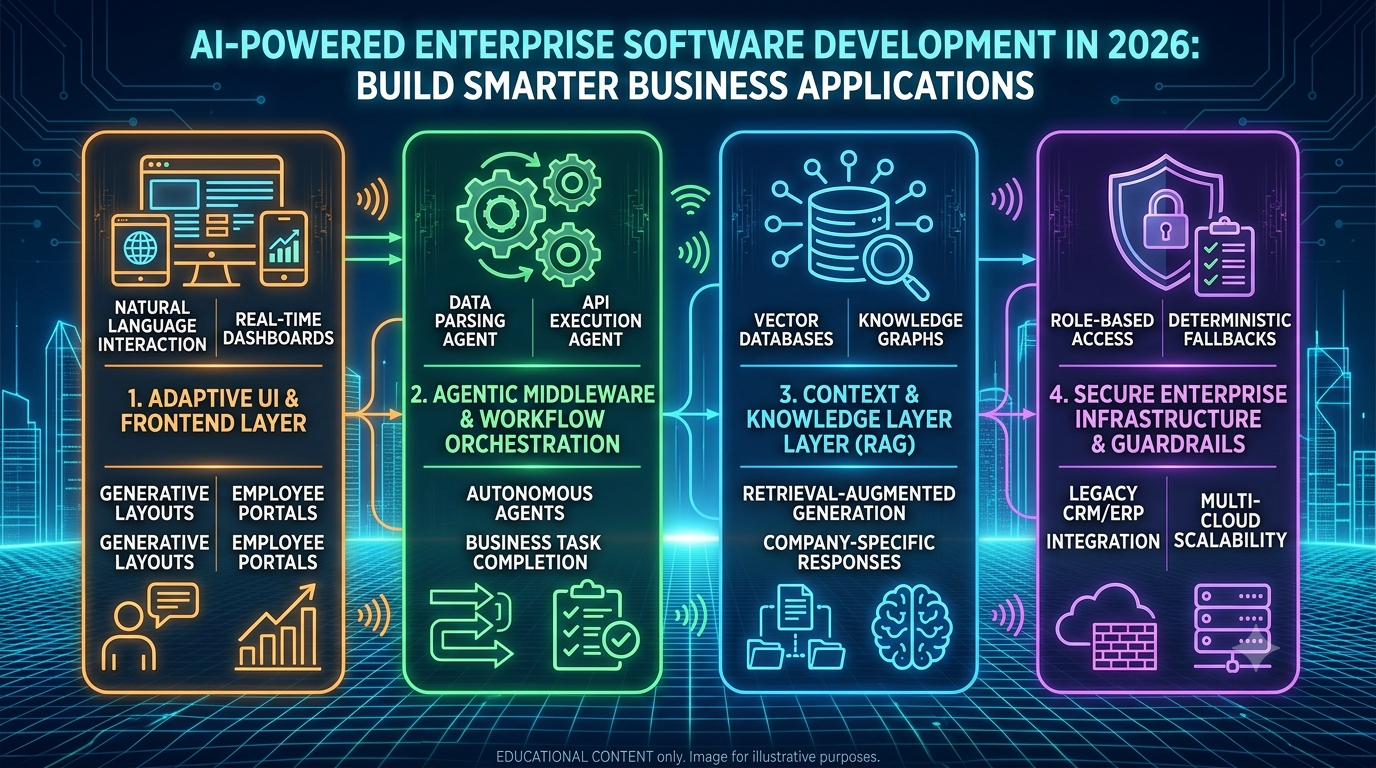
A scalable AI-enabled enterprise application can include several layers.
Frontend Layer
The user interface may be developed for:
- Web
- Mobile
- Desktop
- Internal employee portals
Application Layer
This layer manages:
- Business logic
- Authentication
- User permissions
- APIs
- Workflow management
- Application services
AI Layer
The AI layer can include:
- Large language models
- Machine learning models
- Generative AI
- AI agents
- Recommendation engines
- Document intelligence
- Natural language processing
Data Layer
Enterprise applications may work with:
- SQL databases
- NoSQL databases
- Data warehouses
- Cloud storage
- Vector databases
- Business documents
Integration Layer
Enterprise software frequently needs to connect with existing systems such as:
- CRM platforms
- ERP systems
- Payment systems
- HR software
- Accounting systems
- E-commerce platforms
- Marketing platforms
- Internal APIs
RAG for Enterprise Applications
Retrieval-Augmented Generation (RAG) is useful when an AI application needs to work with company-specific information.
A typical workflow is:
User Question → Search Knowledge Base → Retrieve Relevant Data → AI Model → Grounded Response
For example, an employee could ask:
“What is our current enterprise refund policy?”
The system can search approved company documents and use the relevant information to generate a response.
RAG can be useful for:
- Internal knowledge assistants
- Customer support
- Legal document search
- Product documentation
- Employee portals
- Technical support
- Enterprise search
AI-Powered Customer Service Software
Customer service is another important enterprise use case.
An AI-enabled support platform can:
- Categorize tickets
- Summarize conversations
- Suggest responses
- Search knowledge bases
- Identify customer intent
- Route tickets
- Detect priority issues
- Assist support representatives
Human agents can remain responsible for complex or sensitive cases.
AI in CRM and Sales Applications
AI can make CRM systems more useful by turning customer data into actionable information.
Possible capabilities include:
- Lead scoring
- Customer segmentation
- Sales forecasting
- Email assistance
- Meeting summaries
- Opportunity analysis
- Customer recommendations
- Follow-up automation
Instead of requiring sales teams to manually analyze every record, AI can help surface relevant information.
AI-Powered Enterprise Analytics
Enterprise businesses generate large volumes of data.
AI can help convert this information into insights.
A modern analytics platform may combine:
Business Data + AI Models + Dashboards + Natural Language Queries
For example, management could ask:
“Which product category had the largest decline in sales this month?”
The system can analyze connected business data and provide a result through a natural-language interface.
Enterprise Software Modernization
Many businesses still rely on legacy applications.
Replacing a legacy platform completely can be expensive and disruptive.
An alternative approach is gradual modernization.
This may involve:
- Auditing the existing architecture
- Identifying critical legacy components
- Creating APIs around existing systems
- Modernizing the user interface
- Moving selected services to cloud infrastructure
- Introducing automation
- Adding AI capabilities
- Improving security and monitoring
This approach can allow businesses to modernize their software without replacing everything at once.
Cloud-Based Enterprise Software Development
Cloud infrastructure provides important capabilities for modern enterprise applications.
Cloud-based systems can support:
- Scalable computing
- Managed databases
- API infrastructure
- Data storage
- Monitoring
- Backup
- Security controls
- AI services
Depending on requirements, businesses may choose public cloud, private cloud, hybrid cloud, or multi-cloud architectures.
Enterprise API Integration
Enterprise software rarely operates in isolation.
A new application may need to communicate with several existing platforms.
API integration can connect:
Enterprise Application ↔ CRM ↔ ERP ↔ Payment System ↔ Analytics ↔ AI Services
Well-designed APIs can make the architecture more modular and easier to maintain.
Security in AI-Powered Enterprise Software
AI introduces additional security considerations.
Enterprise applications should address:
- Identity management
- Role-based access
- Encryption
- API security
- Data access controls
- Audit logging
- Secure secrets management
- AI input validation
- Prompt injection risks
- Model and tool permissions
AI agents require particular attention because an agent with access to business systems may be able to perform actions rather than simply provide information.
Recent industry reporting also highlights the need for enterprises to extend security and Zero Trust approaches to AI applications, agents, and APIs.
Human Oversight and AI Governance
Not every business decision should be fully automated.
Enterprise AI applications should define which tasks can be automated and which require human approval.
For example:
| Task | Possible Approach |
|---|---|
| Generate report draft | AI automation |
| Categorize support ticket | AI automation |
| Recommend sales action | AI + human review |
| Update customer information | Controlled automation |
| Approve large financial transaction | Human approval |
| Make high-impact business decision | Human oversight |
The appropriate level of automation depends on the business process and associated risks.
How to Build Enterprise Software With AI
A successful development process should start with business requirements rather than technology alone.
Step 1: Identify the Business Problem
Define the process that needs improvement.
Ask:
- What is currently manual?
- Where are employees losing time?
- What information is difficult to access?
- Which workflow creates the most operational friction?
Step 2: Define AI Use Cases
Not every feature needs AI.
Identify areas where AI can provide measurable value.
Step 3: Design the Architecture
Plan:
- Frontend
- Backend
- Database
- APIs
- AI models
- Authentication
- Security
- Cloud infrastructure
Step 4: Build an MVP
Develop the most important workflow first.
An MVP helps validate:
- User experience
- Technical architecture
- AI performance
- Integration requirements
- Operating costs
Step 5: Integrate Business Data
Connect the required CRM, ERP, databases, documents, APIs, and other systems.
Step 6: Add Automation
Once the core application works reliably, automate appropriate workflows.
Step 7: Test and Monitor
Testing should cover both software and AI behavior.
Important metrics include:
- Accuracy
- Response time
- Reliability
- Security
- AI usage
- Infrastructure cost
- User adoption
Step 8: Scale
After validating the application, expand features, integrations, users, and AI capabilities.
How Much Does Enterprise Software Development Cost?
The cost of enterprise software development varies significantly depending on the project.
Major factors include:
- Number of users
- Application complexity
- Number of platforms
- UI/UX requirements
- AI functionality
- Database architecture
- API integrations
- Cloud infrastructure
- Security requirements
- Compliance requirements
- Admin dashboards
- Automation workflows
- Maintenance requirements
A small internal business application may require a relatively limited development effort, while a global enterprise platform can involve multiple development teams and long-term infrastructure costs.
AI can also introduce usage-based costs through model inference, data processing, storage, and third-party services.
Common Enterprise Software Development Challenges
Legacy System Integration
Existing systems may use outdated technologies or limited APIs.
Data Quality
AI systems depend heavily on the quality, structure, and accessibility of business data.
Security
More connected systems create a larger security surface.
AI Reliability
AI-generated output needs appropriate validation, monitoring, and safeguards.
Cost Management
AI usage can create variable costs, making monitoring and budgeting important.
Change Management
Employees need training and clear workflows when AI changes how work is performed.
Why Choose SquareBits for Enterprise Software Development?
Enterprise software requires more than coding.
It requires an understanding of business processes, architecture, integrations, security, scalability, and user experience.
SquareBits can help businesses develop and modernize software solutions around their specific operational requirements.
Enterprise software development services can include:
- Custom software development
- Web application development
- Mobile application development
- Enterprise application development
- AI integration
- Business automation
- API development
- Cloud application development
- Database development
- Software modernization
- Third-party integrations
- Maintenance and support
The objective is to create software that fits the business rather than forcing the business to adapt to a generic workflow.
The Future of Enterprise Software Development
Enterprise software is moving toward applications that are more intelligent, connected, automated, and context-aware.
Industry research in 2026 points toward greater adoption of agentic AI, AI-first products, and software that can interact with business processes.
The next generation of enterprise applications is likely to combine:
Custom Software + AI + Automation + APIs + Cloud + Business Data
However, successful implementation will depend on more than simply adding AI. Businesses will need strong architecture, data governance, security, monitoring, and clearly defined business outcomes.
Build Your Enterprise Software With SquareBits
Whether you need a new enterprise application, an AI-powered business platform, a workflow automation solution, or modernization of an existing system, the right software architecture can create a foundation for long-term growth.
SquareBits helps businesses turn software requirements into scalable digital solutions by combining application development, AI capabilities, integrations, automation, and modern cloud technologies.
If your business is planning a new software platform in 2026, start by identifying the business problem, defining measurable outcomes, and designing an architecture that can evolve as your requirements grow.
Frequently Asked Questions
What is enterprise software development?
Enterprise software development is the process of designing and building applications that support the complex operational, data, workflow, and integration requirements of organizations.
What is AI-powered enterprise software?
AI-powered enterprise software combines traditional business application functionality with artificial intelligence for capabilities such as automation, natural-language interaction, prediction, document processing, recommendations, and AI agents.
How long does enterprise software development take?
Development time depends on the application’s features, integrations, number of users, security requirements, platforms, and complexity. An MVP can generally be delivered faster than a large enterprise platform.
Can AI be added to existing enterprise software?
Yes. AI can be integrated into existing applications through APIs, AI services, RAG systems, machine learning models, and AI agents.
Can enterprise software connect with existing CRM and ERP systems?
Yes. APIs, middleware, connectors, and custom integration services can connect enterprise applications with existing CRM, ERP, payment, HR, accounting, and other business platforms.
How much does custom enterprise software cost?
There is no single fixed price. Cost depends on application complexity, integrations, AI functionality, security, infrastructure, number of users, and ongoing maintenance.
Why choose custom enterprise software instead of off-the-shelf software?
Custom software can be designed around a company’s specific workflows, integrations, data requirements, and business processes rather than requiring the organization to adapt to a generic product.
SEO Information
Primary Keyword: Enterprise software development
Secondary Keywords:
- enterprise software development company
- custom enterprise software development
- enterprise application development
- AI software development
- AI-powered enterprise software
- custom software development
- enterprise application development company
- business automation software
- AI development services
- enterprise AI development
- software modernization
- custom business software
- enterprise software solutions
SEO Title:
Enterprise Software Development in 2026: AI, Automation & Custom Solutions
Meta Description:
Explore enterprise software development in 2026, including AI-powered applications, automation, enterprise integrations, cloud architecture, security, costs, and modernization.
Suggested URL Slug:/enterprise-software-development-2026/
Leave a Reply