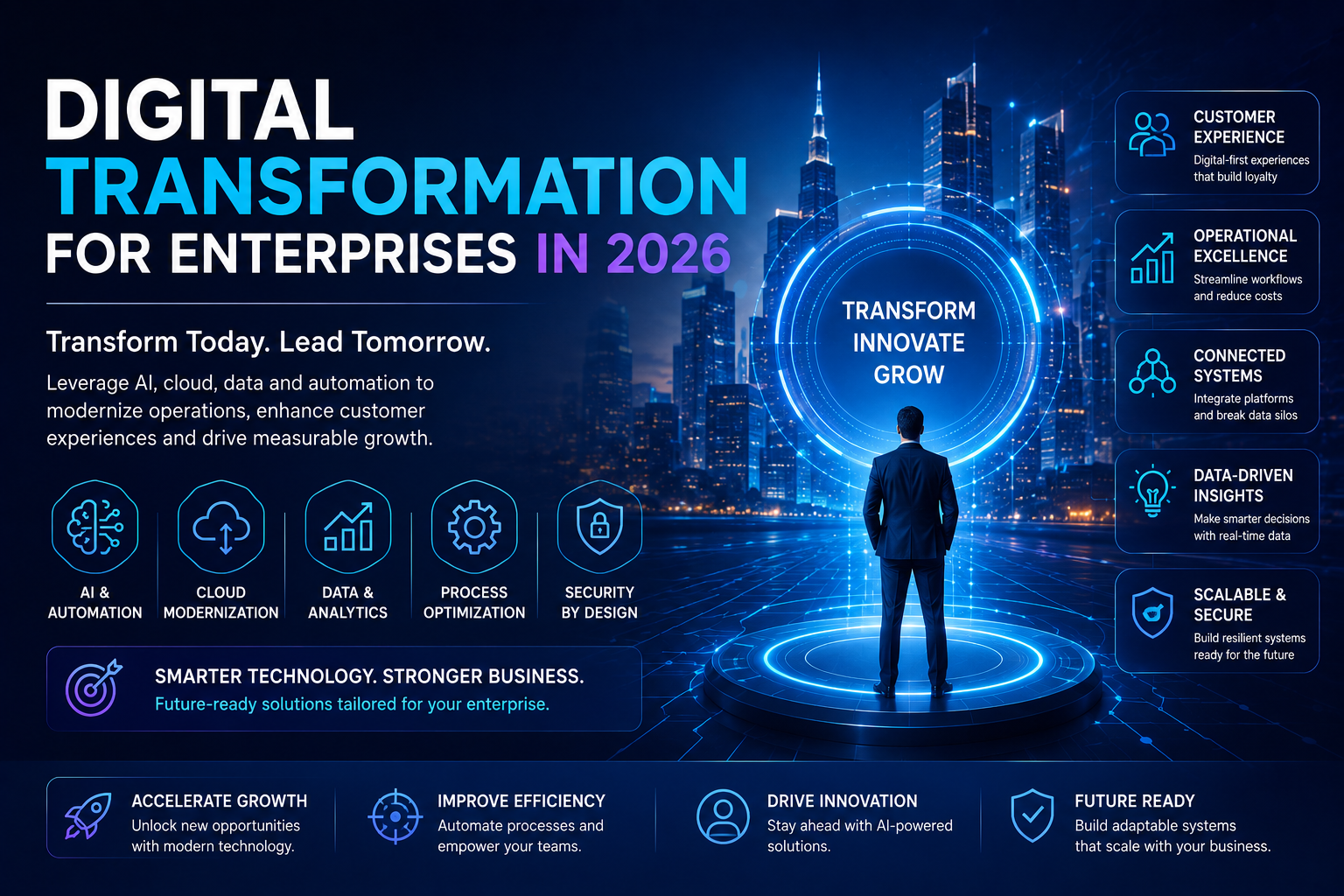
Digital transformation is no longer simply about moving business processes online.
For enterprises, it means fundamentally improving how people, technology, data, and processes work together.
In 2026, organizations are increasingly combining AI, cloud computing, automation, data analytics, modern applications, APIs, and cybersecurity to create more connected and efficient operations.
The challenge is not deciding whether digital transformation is important.
The real challenge is deciding where to start, which technologies to adopt, and how to transform without disrupting existing business operations.
What Is Enterprise Digital Transformation?
Enterprise digital transformation is the process of using modern digital technologies to improve business operations, customer experiences, decision-making, and organizational efficiency.
A transformation initiative can involve:
- Modernizing legacy applications
- Moving workloads to the cloud
- Automating repetitive processes
- Integrating disconnected systems
- Implementing AI
- Improving data analytics
- Developing custom enterprise applications
- Digitizing manual workflows
- Strengthening cybersecurity
- Improving customer and employee experiences
Digital transformation isn’t a single software project.
It is an ongoing process of improving how an organization operates through technology.
Why Digital Transformation Matters in 2026
Enterprises are operating in an increasingly competitive environment.
Customers expect faster digital experiences. Employees expect modern tools. Management needs real-time information. Meanwhile, organizations must control costs and respond quickly to market changes.
Legacy systems can make these goals difficult.
A business may have:
CRM + ERP + HR System + Finance Software + Legacy Applications + Spreadsheets + Separate Databases
When these systems don’t communicate effectively, employees may spend significant time moving information between platforms.
Digital transformation aims to create a more connected environment:
Business Systems → APIs → Shared Data → Automation → AI → Intelligent Decisions
Key Enterprise Digital Transformation Trends in 2026
1. AI-Powered Business Operations
Artificial intelligence is becoming a major component of enterprise transformation.
Organizations can use AI for:
- Customer service
- Document processing
- Data analysis
- Business intelligence
- Sales automation
- Employee assistance
- Predictive analytics
- Software development
- Knowledge management
The biggest opportunity is not simply adding a chatbot to an existing website.
Enterprises can integrate AI directly into business workflows.
For example:
Customer Request → AI Understands Request → Retrieves Company Data → Takes Approved Action → Updates CRM
This can reduce repetitive work while allowing employees to focus on higher-value activities.
2. AI Agents and Intelligent Automation
Traditional automation follows predefined rules.
AI-powered agents can potentially handle more complex workflows by interpreting information, using approved tools, and completing multiple steps.
For example:
Invoice Received → AI Extracts Information → Validates Data → Checks ERP → Flags Exceptions → Sends for Approval
This approach can help enterprises automate workflows that previously required significant manual intervention.
However, enterprise AI agents should operate within clearly defined permissions and security controls.
3. Cloud Modernization
Cloud technology remains an important part of enterprise transformation.
Cloud modernization can help organizations improve:
- Scalability
- Infrastructure flexibility
- Remote accessibility
- Application deployment
- Disaster recovery
- Data availability
- Operational efficiency
However, moving everything to the cloud isn’t automatically a transformation strategy.
Enterprises should first determine:
Which workloads should move?
Which applications should be modernized?
Which systems should remain on-premises?
Which architecture provides the best long-term value?
A hybrid approach may be the right solution for many organizations.
4. Legacy Application Modernization
Legacy software can become one of the biggest barriers to enterprise transformation.
Older systems may still perform critical business functions but can be difficult to:
- Maintain
- Integrate
- Scale
- Secure
- Update
Organizations don’t always need to replace legacy systems completely.
Modernization strategies can include:
- API integration
- Cloud migration
- Database modernization
- Application refactoring
- Microservices
- New frontend development
- Automated testing
- Incremental replacement
A phased approach can reduce operational risk.
5. Enterprise API Integration
APIs are the connective tissue of modern enterprise technology.
An enterprise might need to connect:
CRM + ERP + E-Commerce + Payment System + Mobile App + Data Warehouse + AI Platform
Without integration, these systems can become isolated information silos.
APIs can allow applications to exchange information and trigger workflows.
For example:
E-Commerce Order → API → ERP → Inventory Update → Warehouse → Customer Notification
This creates a connected digital ecosystem.
6. Data-Driven Decision Making
Enterprise transformation is also a data transformation.
Organizations generate enormous amounts of information from:
- Customer interactions
- Sales
- Finance
- Operations
- Employees
- Supply chains
- Applications
- IoT devices
But collecting data is not enough.
Businesses need to turn data into useful information.
A modern analytics architecture can look like:
Data Sources → Data Platform → Analytics → AI → Business Insights
This enables decision-makers to move from assumptions toward data-driven strategies.
7. Digital Customer Experiences
Customers increasingly expect businesses to provide convenient digital experiences.
Depending on the industry, this may include:
- Mobile applications
- Self-service portals
- Personalized dashboards
- Digital onboarding
- Online payments
- AI assistants
- Real-time notifications
- Omnichannel communication
A poor digital experience can affect customer satisfaction even when the underlying product is strong.
Digital transformation therefore needs to consider the entire customer journey.
8. Cybersecurity by Design
As enterprises become more digitally connected, their attack surface can also increase.
Transformation initiatives should therefore include security from the beginning.
Important areas include:
- Identity management
- Access control
- Encryption
- API security
- Cloud security
- Endpoint protection
- Network security
- Security monitoring
- Data protection
- Incident response
Security should not be treated as an afterthought.
A better approach is:
Secure Architecture → Secure Development → Secure Deployment → Continuous Monitoring
Digital Transformation Challenges for Enterprises
Technology isn’t usually the only challenge.
Enterprise transformation can fail because of organizational and operational issues.
Resistance to Change
Employees may be comfortable with existing processes.
Organizations need effective communication, training, and change management.
Legacy Systems
Critical business processes may depend on older applications.
Replacing them immediately can create significant risk.
Data Silos
Different departments may use different systems and data formats.
Integration becomes essential.
Budget Constraints
Transformation projects can require substantial investment.
Enterprises should prioritize projects based on measurable business value.
Lack of Technical Expertise
Organizations may have strong internal teams but still require specialized expertise in areas such as:
- AI
- Cloud
- Data engineering
- Cybersecurity
- Application modernization
- Enterprise integration
Strategic technology partnerships can help fill these gaps.
How to Create a Digital Transformation Strategy
A successful transformation should start with business objectives.
Step 1: Identify Business Problems
Don’t start with:
“We need AI.”
Start with:
“What business problem are we trying to solve?”
For example:
- Reduce customer-support costs
- Improve operational efficiency
- Increase sales
- Reduce manual data entry
- Improve reporting
- Modernize legacy applications
Step 2: Audit Existing Technology
Review:
- Applications
- Databases
- Infrastructure
- Integrations
- Security
- Workflows
- Data quality
This provides a realistic picture of the current technology environment.
Step 3: Prioritize Opportunities
Not every system needs to be transformed at the same time.
Prioritize projects based on:
Business Impact + Feasibility + Cost + Risk
Step 4: Build a Transformation Roadmap
Create a phased roadmap.
For example:
Phase 1
Application and infrastructure assessment.
Phase 2
API integration and workflow automation.
Phase 3
Cloud and application modernization.
Phase 4
AI and advanced analytics.
Phase 5
Continuous optimization.
This reduces the risk associated with attempting a massive transformation all at once.
Custom Software and Digital Transformation
Off-the-shelf software works well for many standard business requirements.
However, enterprises often have unique workflows.
Custom software can help organizations build technology around their specific processes.
Examples include:
- Enterprise dashboards
- Customer portals
- Workflow platforms
- AI applications
- Internal business applications
- Mobile workforce applications
- Industry-specific software
- Integration platforms
Custom development can also be used to connect existing systems rather than replacing everything.
How AI and Automation Work Together
AI and automation are often more powerful when used together.
Consider a traditional workflow:
Employee Reads Email → Extracts Information → Opens ERP → Enters Data → Sends Confirmation
An intelligent workflow could become:
Email → AI Extracts Information → Validates Data → API Updates ERP → Automated Confirmation
The employee can then focus on exceptions rather than repetitive data entry.
This is where enterprise AI can create measurable operational value.
Measuring Digital Transformation ROI
Digital transformation should be measurable.
Enterprises can track metrics such as:
Operational Efficiency
How much manual work has been reduced?
Cost Reduction
Has the transformation lowered operational costs?
Revenue
Has the digital experience created additional revenue opportunities?
Customer Experience
Are customers completing processes faster?
Employee Productivity
Are employees spending less time on repetitive tasks?
System Performance
Have application speed, availability, and scalability improved?
Automation Rate
What percentage of eligible processes are now automated?
Without measurable outcomes, digital transformation can become a technology project without a clear business case.
Why Enterprises Need a Scalable Technology Architecture
A transformation project should not solve today’s problem while creating tomorrow’s limitation.
Enterprise architecture should consider:
- Scalability
- Security
- Performance
- Integration
- Maintainability
- Data governance
- Disaster recovery
- Cloud strategy
- AI readiness
The objective is to create an architecture that can evolve as business requirements change.
The Role of a Digital Transformation Technology Partner
Enterprise transformation often requires multiple technical disciplines.
A technology partner can support areas such as:
- Digital strategy
- Custom software development
- AI application development
- Cloud modernization
- Mobile and web development
- API integration
- Data engineering
- Automation
- Cybersecurity
- Application modernization
The right partner should understand both technology and business objectives.
The goal should not be to sell the newest technology.
The goal should be to determine which technology can produce the greatest business impact.
Why Choose SquareBits for Digital Transformation?
Enterprise transformation requires more than isolated development services.
Organizations need a technology partner capable of understanding existing systems, designing scalable architectures, building modern applications, and connecting technology ecosystems.
SquareBits can help enterprises approach digital transformation through a combination of software engineering, modern application development, AI, automation, integration, and technology modernization.
A transformation engagement can begin with a practical assessment:
Current Technology → Business Challenges → Transformation Opportunities → Technology Roadmap → Development → Deployment → Continuous Improvement
This approach allows enterprises to prioritize meaningful improvements instead of attempting to transform everything simultaneously.
The Future of Enterprise Digital Transformation
The next stage of digital transformation will increasingly combine:
AI + Automation + Cloud + Data + APIs + Modern Applications
AI agents will handle more business workflows.
Cloud platforms will provide scalable infrastructure.
APIs will connect previously isolated systems.
Analytics will help organizations understand their operations.
Automation will reduce repetitive work.
And custom applications will provide experiences tailored to specific business requirements.
The result will be enterprises that are more connected, data-driven, and adaptable.
Conclusion
Digital transformation in 2026 is not simply about replacing old software with new software.
It is about creating a smarter digital foundation for the entire organization.
Enterprises can achieve this by combining AI, automation, cloud modernization, APIs, data analytics, cybersecurity, and custom software development around clearly defined business objectives.
The most successful transformation projects begin with a simple question:
“What business outcome do we want technology to improve?”
Once that question is answered, technology becomes the tool—not the goal.
For enterprises ready to modernize their operations, improve customer experiences, and build scalable digital capabilities, the next step is to assess the current technology environment and create a practical transformation roadmap.
Digital transformation doesn’t have to happen all at once. It starts with the right first step.
Leave a Reply