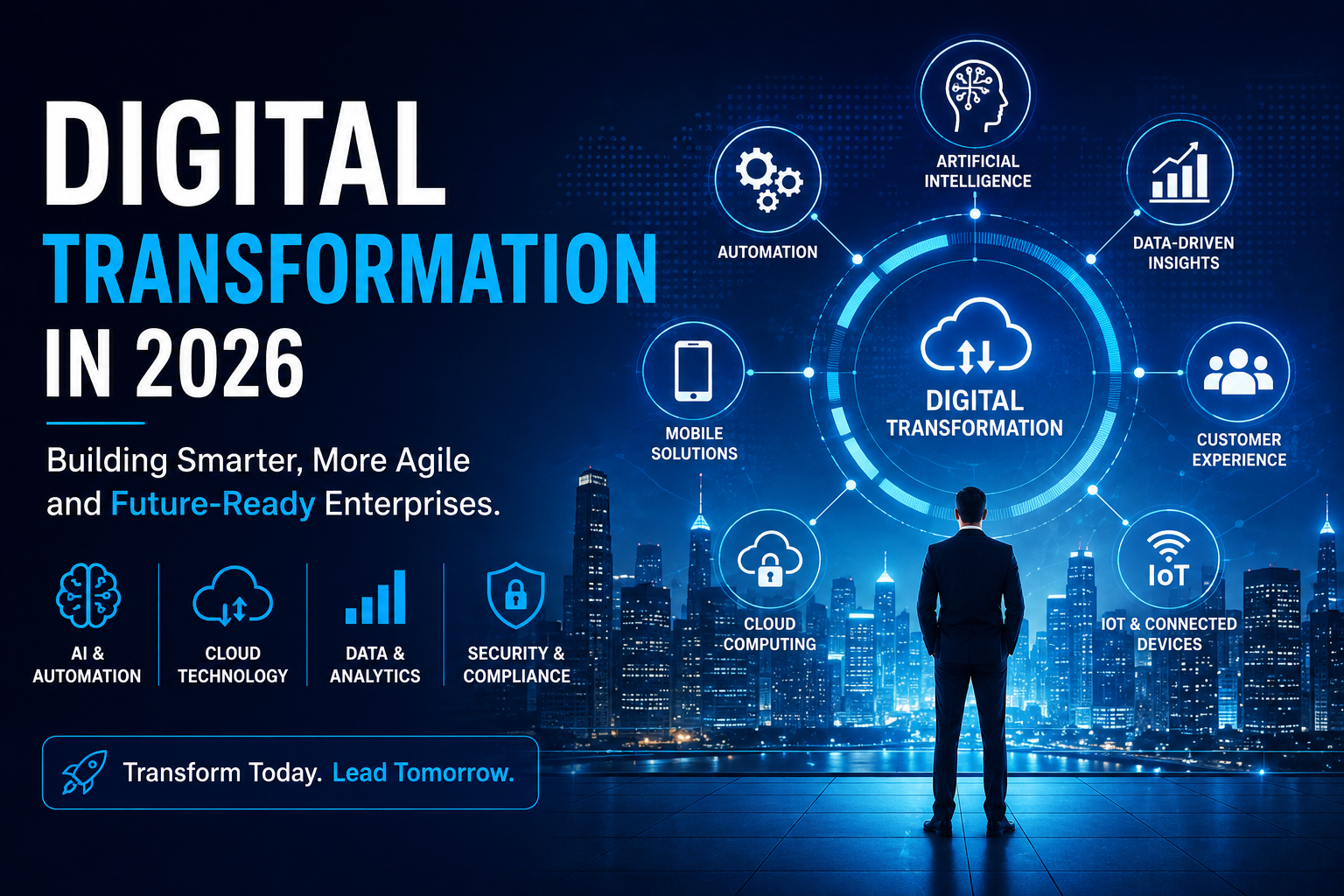
Digital transformation has moved beyond simply adopting new software. In 2026, enterprises are using technology to redesign business processes, improve customer experiences, automate repetitive work, and make faster data-driven decisions.
From artificial intelligence and cloud computing to automation and connected applications, modern technologies are creating new opportunities for organizations across industries.
For enterprises, the challenge is no longer whether to digitally transform. The bigger question is how to build a transformation strategy that delivers measurable business value.
What Is Digital Transformation?
Digital transformation is the process of using digital technologies to improve how an organization operates, serves customers, manages information, and creates value.
It can involve transforming:
- Business processes
- Customer experiences
- Internal operations
- Data management
- Employee workflows
- Software infrastructure
- Communication systems
- Decision-making processes
Digital transformation is therefore a business strategy as much as it is a technology initiative.
Why Digital Transformation Matters in 2026
Enterprise competition is becoming increasingly technology-driven.
Customers expect faster services, employees need efficient digital tools, and businesses require real-time information to make informed decisions.
A strong digital transformation strategy can help enterprises:
- Reduce operational costs
- Improve productivity
- Automate repetitive processes
- Improve customer experiences
- Increase business agility
- Make better use of data
- Create new digital products and services
- Improve collaboration between teams
Organizations that delay modernization may find it increasingly difficult to compete with digitally mature businesses.
Key Technologies Driving Enterprise Transformation
1. Artificial Intelligence
Artificial intelligence has become one of the biggest drivers of enterprise transformation.
Businesses can use AI for:
- Customer support
- Document processing
- Data analysis
- Predictive analytics
- Fraud detection
- Sales forecasting
- Recommendation systems
- Workflow automation
Generative AI is also helping employees create content, summarize information, analyze documents, and interact with enterprise knowledge more efficiently.
The goal should not simply be to add AI to existing applications. Enterprises should identify business processes where AI can create measurable improvements.
2. Cloud Computing
Cloud technology provides enterprises with scalable infrastructure and flexible access to applications and data.
Cloud-based systems can support:
- Remote work
- Data analytics
- Application development
- Business continuity
- Infrastructure scalability
- Multi-location operations
Cloud migration can also help enterprises modernize legacy infrastructure and create a foundation for future digital initiatives.
3. Business Process Automation
Many organizations still depend on repetitive manual tasks.
Automation can streamline activities such as:
- Data entry
- Invoice processing
- Employee onboarding
- Report generation
- Customer notifications
- Approval workflows
- Document management
By automating repetitive work, employees can spend more time on activities that require creativity, decision-making, and customer interaction.
4. Data and Analytics
Data is one of the most valuable assets available to modern enterprises.
Organizations can collect information from:
- Websites
- Mobile applications
- CRM systems
- ERP platforms
- IoT devices
- Customer interactions
- Sales systems
Advanced analytics can transform this information into useful business insights.
For example, enterprises can use data to understand customer behavior, forecast demand, identify operational problems, and measure business performance.
5. Mobile Applications
Mobile applications can improve communication between businesses, employees, partners, and customers.
Enterprise mobile applications can support:
- Field-service operations
- Employee communication
- Customer engagement
- Sales management
- Inventory management
- Business dashboards
- Secure access to enterprise systems
A mobile-first approach can help organizations deliver services wherever their users are located.
6. IoT and Connected Devices
The Internet of Things is helping enterprises connect physical operations with digital platforms.
IoT solutions can monitor:
- Equipment
- Vehicles
- Environmental conditions
- Inventory
- Industrial assets
- Energy consumption
Real-time sensor data can be sent to cloud platforms for monitoring and analysis.
This can help enterprises improve operational visibility and support predictive maintenance.
Digital Transformation for Different Enterprise Functions
Customer Experience
Customers increasingly expect personalized and convenient digital experiences.
Enterprises can use digital platforms to provide:
- Personalized recommendations
- Self-service portals
- Mobile applications
- AI-powered support
- Omnichannel communication
- Faster digital transactions
A better digital experience can improve customer satisfaction and retention.
Operations
Digital transformation can eliminate unnecessary manual processes and improve coordination between departments.
Integrated systems can give management a more complete view of business operations.
Human Resources
HR teams can use digital platforms for:
- Recruitment
- Employee onboarding
- Attendance
- Performance management
- Training
- Employee communication
AI and automation can further reduce administrative workloads.
Sales and Marketing
CRM systems, marketing automation, analytics, and AI can help sales and marketing teams understand customers and improve engagement.
Businesses can analyze customer interactions and identify opportunities throughout the sales journey.
Modernizing Legacy Enterprise Systems
Legacy systems remain a major challenge for many organizations.
Older applications may be expensive to maintain and difficult to integrate with modern technologies.
Instead of replacing everything at once, enterprises can consider gradual modernization approaches such as:
- API integration
- Cloud migration
- Microservices
- Application modernization
- Database modernization
- Hybrid architecture
A phased strategy can reduce disruption while allowing businesses to modernize critical systems over time.
Cybersecurity and Digital Transformation
As enterprises become more digitally connected, cybersecurity becomes increasingly important.
A transformation strategy should include:
- Identity and access management
- Data encryption
- Secure APIs
- Multi-factor authentication
- Network security
- Security monitoring
- Backup and recovery
- Regular vulnerability testing
Security should be integrated into the architecture from the beginning rather than treated as a final development step.
Common Digital Transformation Challenges
Digital transformation can deliver significant benefits, but enterprises often face several challenges.
Resistance to Change
Employees may be comfortable with existing systems and processes. Organizations should provide training and communicate the benefits of new technologies clearly.
Legacy Infrastructure
Older systems may not easily integrate with modern platforms.
Data Silos
When information is distributed across disconnected applications, organizations may struggle to obtain a complete view of their operations.
Budget Constraints
Transformation initiatives require investment in technology, development, training, and security.
Lack of Clear Strategy
Technology adoption without clearly defined business objectives can produce limited results.
How Enterprises Can Build a Successful Transformation Strategy
A successful digital transformation program should start with business goals.
Step 1: Identify Business Problems
Determine which processes create the greatest cost, delays, or inefficiencies.
Step 2: Define Measurable Goals
Set clear objectives such as reducing processing time, improving customer satisfaction, or increasing operational efficiency.
Step 3: Prioritize High-Impact Projects
Start with initiatives that can deliver measurable value rather than attempting to transform everything simultaneously.
Step 4: Select the Right Technology
Choose technologies based on business requirements rather than following trends simply because they are popular.
Step 5: Build and Integrate
Develop or modernize applications and connect them with existing enterprise systems.
Step 6: Test and Measure
Monitor performance and compare results against the original business objectives.
Step 7: Continuously Improve
Digital transformation is an ongoing process. Enterprises should continuously evaluate technologies, processes, and customer needs.
The Future of Enterprise Digital Transformation
The next phase of digital transformation will increasingly focus on intelligent and connected organizations.
Enterprises are expected to combine:
- Artificial intelligence
- Automation
- Cloud computing
- IoT
- Advanced analytics
- Mobile applications
- Cybersecurity
- Digital platforms
AI agents and intelligent automation may also take on increasingly complex business tasks, working alongside employees rather than simply replacing individual manual activities.
The result will be more adaptive organizations capable of responding quickly to changing market conditions.
Conclusion
Digital transformation in 2026 is about creating smarter, faster, and more connected enterprises. Organizations can combine AI, cloud computing, automation, mobile applications, IoT, analytics, and secure digital platforms to improve operations and create better customer experiences.
However, successful transformation is not about adopting every new technology. It is about identifying real business problems and using the right technology to solve them.
For enterprises planning their next stage of digital growth, a well-planned and measurable transformation strategy can create a strong foundation for long-term competitiveness.
Suggested SEO Keywords: digital transformation, enterprise digital transformation, digital transformation services, digital transformation strategy, business digital transformation, enterprise software development, AI digital transformation, cloud transformation, business process automation, digital transformation solutions
Leave a Reply