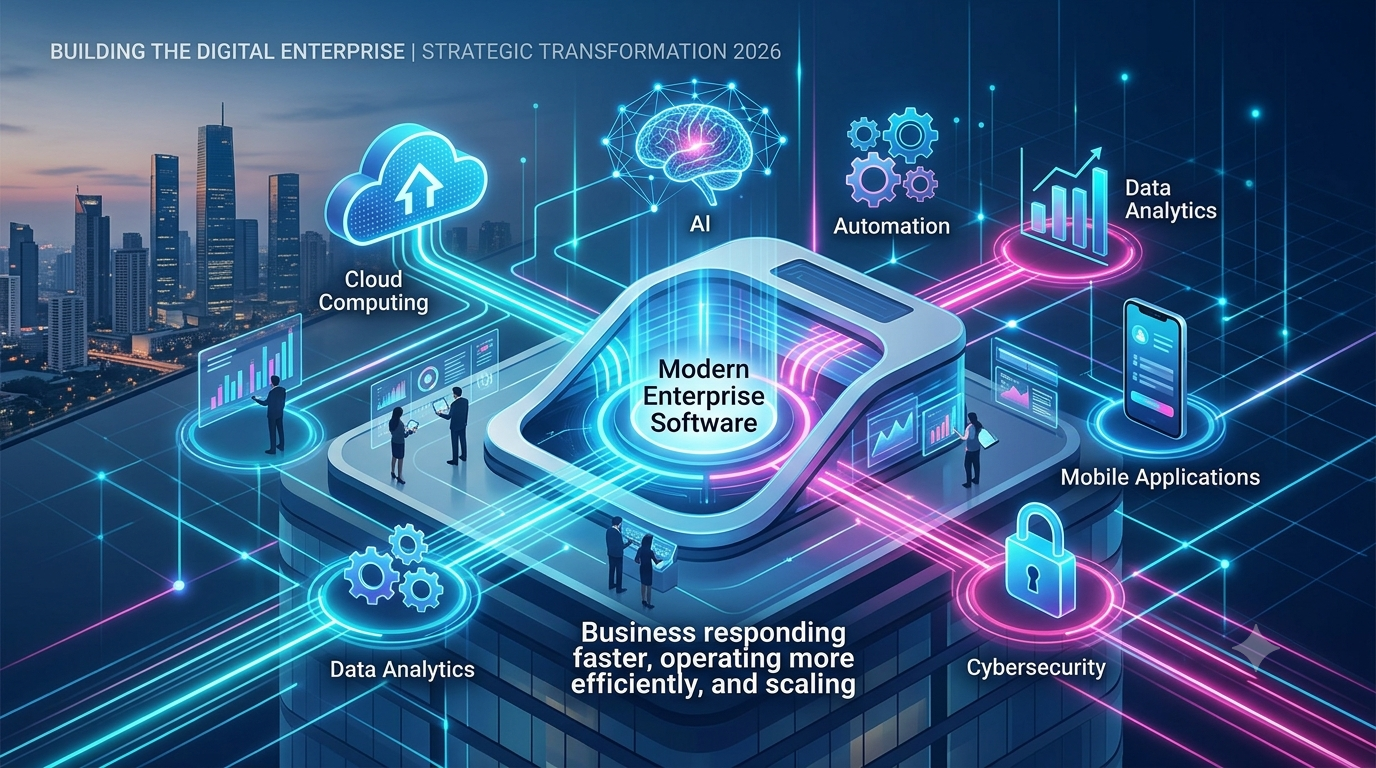
Digital transformation is no longer simply about moving business processes online. In 2026, organizations are increasingly using AI, cloud computing, automation, data analytics, mobile applications, and modern software platforms to rethink how their businesses operate.
For enterprises, the goal is not just to adopt new technology.
The real objective is to create a business that can respond faster, operate more efficiently, understand customers better, and scale without unnecessary complexity.
This is where modern digital transformation becomes a strategic business initiative rather than an IT project.
What Is Digital Transformation?
Digital transformation is the process of using digital technologies to improve business operations, customer experiences, decision-making, and overall business models.
It can involve:
- Cloud migration
- Artificial intelligence
- Business automation
- Mobile applications
- Data analytics
- Enterprise software
- API integrations
- Cybersecurity
- Digital customer experiences
- Legacy system modernization
However, successful transformation isn’t about implementing every new technology.
It is about identifying where technology can create measurable business value.
Why Digital Transformation Matters in 2026
Businesses are operating in an environment where customers expect faster services, employees expect better digital tools, and competitors are adopting technology at an increasingly rapid pace.
Organizations that continue relying on disconnected legacy systems may face challenges such as:
- Slow decision-making
- Manual processes
- Data silos
- Higher operational costs
- Poor customer experiences
- Difficult system integration
- Limited scalability
Digital transformation provides an opportunity to address these challenges through connected and intelligent technology.
AI Is Changing Enterprise Digital Transformation
Artificial intelligence has become one of the most important components of modern digital transformation.
Businesses can use AI for:
- Customer support
- Document processing
- Data analysis
- Predictive analytics
- Recommendation systems
- Workflow automation
- Fraud detection
- Business forecasting
- Content generation
The biggest opportunity isn’t simply adding an AI chatbot to a website.
The greater opportunity is integrating AI into existing business workflows.
For example:
Business Data → AI Analysis → Insight → Automated Action
This can turn large amounts of business data into practical recommendations and automated processes.
Cloud Technology Is the Foundation of Modern Businesses
Cloud computing has become an important foundation for digital transformation.
Cloud infrastructure can provide organizations with:
- Scalable computing
- Flexible storage
- Remote accessibility
- Faster deployment
- API connectivity
- Disaster recovery
- Centralized data management
Instead of maintaining every component within traditional infrastructure, businesses can use cloud platforms to build more flexible digital environments.
For enterprises operating across multiple locations, cloud-based systems can also simplify access to business applications and data.
Legacy Modernization Is a Major Priority
Many established organizations still depend on older software systems.
These systems may continue to perform essential business functions, but they can become difficult to maintain or integrate with modern applications.
Legacy modernization can involve:
- Rebuilding outdated applications
- Migrating systems to the cloud
- Developing APIs
- Replacing outdated databases
- Modernizing user interfaces
- Connecting old and new platforms
The objective isn’t always to completely replace an existing system.
Sometimes the better strategy is to gradually modernize it while keeping critical business operations running.
Data Is Becoming a Strategic Business Asset
Every digital interaction generates information.
Businesses collect data from:
- Websites
- Mobile applications
- Customer interactions
- Transactions
- Enterprise systems
- IoT devices
- Marketing platforms
- Support systems
But collecting data isn’t enough.
Organizations need to make that data accessible, reliable, and useful.
A modern data strategy can help businesses move from:
Raw Data → Organized Data → Analytics → Insights → Business Decisions
This can support better forecasting, customer understanding, operational planning, and strategic decision-making.
Automation Can Reduce Operational Complexity
Many organizations still rely on repetitive manual processes.
Examples include:
- Data entry
- Report generation
- Customer notifications
- Invoice processing
- Employee workflows
- Document management
- Approval processes
Business automation can reduce repetitive work by connecting applications and automatically triggering actions.
For example:
Customer submits request → System validates information → Workflow starts → Team receives notification → Customer receives update
Automation doesn’t necessarily mean removing humans from the process.
Instead, it allows employees to focus on tasks that require judgment, creativity, and human interaction.
Mobile Applications Are Part of the Digital Enterprise
Mobile technology is no longer limited to consumer applications.
Enterprises are increasingly using mobile applications for:
- Employee productivity
- Field operations
- Customer engagement
- Sales management
- Inventory
- Payments
- Communication
- Remote monitoring
A well-designed enterprise mobile application can give employees and customers access to important services wherever they are.
APIs Are Connecting the Digital Ecosystem
Modern businesses rarely operate using a single software platform.
An organization may use separate systems for:
- CRM
- Accounting
- Payments
- Marketing
- Inventory
- Customer support
- Human resources
- Analytics
APIs allow these systems to communicate.
For example:
CRM → API → ERP → Analytics Platform
This reduces data silos and allows businesses to create connected digital workflows.
API integration has therefore become an important part of enterprise software development and digital transformation.
Cybersecurity Must Be Part of Transformation
As businesses become more digital, security becomes increasingly important.
Digital transformation can increase the number of systems, applications, APIs, devices, and users that need protection.
Businesses should consider:
- Identity management
- Access control
- Data encryption
- API security
- Network security
- Application security
- Monitoring
- Vulnerability management
- Backup and recovery
Security should not be added at the end of a transformation project.
It should be included in the architecture from the beginning.
Digital Transformation Is Also About Customer Experience
Technology should ultimately improve the experience of the people using a business.
Customers increasingly expect:
- Fast responses
- Personalized services
- Mobile access
- Simple payment options
- Real-time updates
- Self-service capabilities
- Consistent experiences across channels
Businesses can use digital technologies to create connected customer journeys.
For example:
Website → Mobile App → Customer Account → Support → Personalized Experience
The customer should not feel like they are interacting with five disconnected systems.
How Enterprises Can Start Their Digital Transformation Journey
Digital transformation doesn’t need to happen all at once.
A structured approach can make the process easier to manage.
Step 1: Identify Business Problems
Start with business challenges rather than technology.
Ask:
What is slowing the organization down?
Where are customers experiencing friction?
Which processes consume unnecessary time?
Step 2: Audit Existing Technology
Review existing:
- Applications
- Databases
- Infrastructure
- APIs
- Security systems
- Business processes
This helps identify technology gaps and unnecessary duplication.
Step 3: Prioritize High-Impact Projects
Not every process needs immediate transformation.
Focus on projects that can deliver measurable value.
For example:
- Automating a costly workflow
- Modernizing a customer-facing application
- Improving data visibility
- Integrating disconnected systems
- Migrating critical infrastructure
Step 4: Build a Scalable Architecture
Technology should be designed for future growth.
The architecture should consider:
- Scalability
- Security
- Performance
- Integration
- Maintainability
- Data management
A solution that works for today’s requirements should also have a path toward tomorrow’s requirements.
Step 5: Measure Results
Digital transformation should produce measurable outcomes.
Businesses can track:
- Cost reduction
- Processing time
- Customer satisfaction
- Employee productivity
- Revenue growth
- Conversion rates
- System performance
Technology investment becomes easier to justify when its business impact can be measured.
Common Digital Transformation Mistakes
Organizations can encounter problems when transformation is treated purely as a technology upgrade.
Common mistakes include:
Focusing on Technology Instead of Business Goals
The latest technology isn’t always the right technology.
Trying to Transform Everything at Once
Large transformation programs can become difficult to manage without clear priorities.
Ignoring Employees
Employees need training and support when workflows change.
Underestimating Integration
New applications often need to communicate with existing systems.
Treating Security as an Afterthought
Security should be part of the architecture from day one.
Failing to Measure ROI
Without measurable objectives, it becomes difficult to determine whether transformation is delivering value.
The Future of Digital Transformation
The next phase of digital transformation will increasingly combine multiple technologies.
Businesses will bring together:
AI + Cloud + Automation + Data + APIs + Mobile + Cybersecurity
This combination can create organizations that are more connected and adaptable.
AI can provide intelligence.
Cloud provides scalability.
APIs provide connectivity.
Automation provides efficiency.
Data provides visibility.
Mobile applications provide accessibility.
Cybersecurity protects the ecosystem.
Together, these technologies create the foundation of the digital enterprise.
Why Businesses Need a Strategic Technology Partner
Digital transformation often involves multiple technologies and business functions.
Organizations may need expertise in:
- Enterprise software development
- Cloud solutions
- Mobile applications
- AI development
- API integration
- Data analytics
- Automation
- Cybersecurity
- Legacy modernization
Working with an experienced technology partner can help businesses design and implement solutions based on their specific requirements instead of adopting disconnected technologies.
SquareBits helps businesses explore technology-driven solutions that can support digital transformation, software modernization, application development, and connected digital experiences.
Final Thoughts
Digital transformation in 2026 is no longer about simply replacing paper processes with software.
It is about building smarter, connected, data-driven businesses.
Organizations that successfully combine AI, cloud computing, automation, APIs, mobile applications, and modern enterprise software can improve efficiency while creating better experiences for customers and employees.
The most successful transformation strategy is not necessarily the one that uses the most technology.
It is the one that uses the right technology to solve the right business problems.
Leave a Reply