Technology is no longer just a support system for modern businesses.
It has become part of the way companies operate, serve customers, analyze information, and create new revenue opportunities.
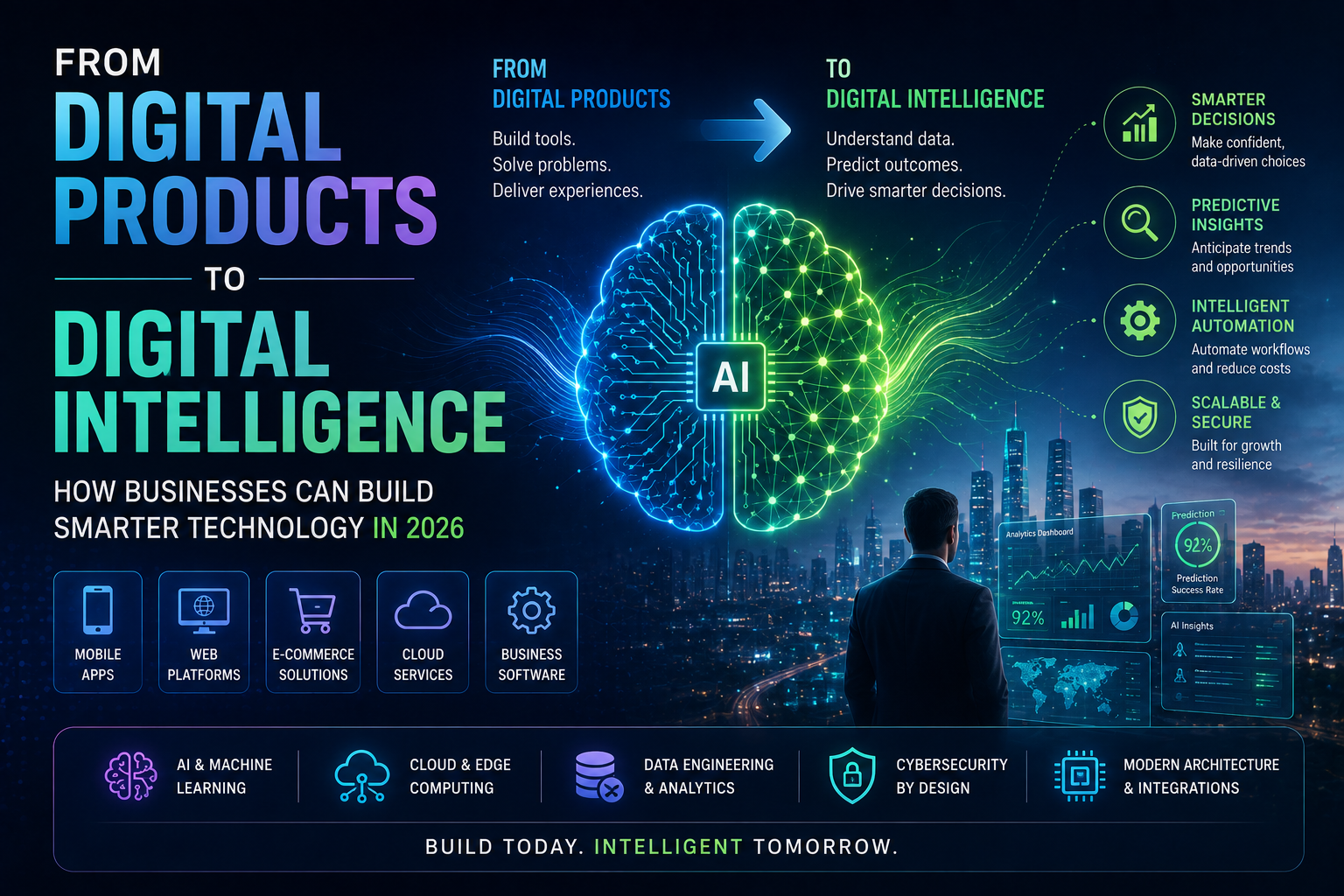
In 2026, businesses are moving beyond traditional software development toward intelligent digital products that can understand data, automate workflows, personalize experiences, and continuously improve.
This shift is creating a new technology model:
Software + AI + Data + Automation + Human Experience = Digital Intelligence
For startups and enterprises, the challenge is no longer simply building an application. The real challenge is building technology that can adapt as the business grows.
What Is Digital Intelligence?
Digital intelligence refers to the ability of software systems to use data, AI, automation, and connected technologies to make processes smarter and more responsive.
A traditional application may help an employee complete a task.
An intelligent application can analyze information, recommend the next action, automate repetitive work, and provide insights that help employees make better decisions.
For example:
Traditional workflow:
Employee → Application → Manual Decision → Action
Intelligent workflow:
Data → AI Analysis → Recommendation → Automated Action → Human Oversight
This evolution is changing how companies approach digital product development.
Why Businesses Are Moving Toward Intelligent Software
Businesses generate enormous amounts of data every day.
Customer interactions, transactions, application activity, inventory, support requests, operational information, and marketing data can all provide valuable insights.
But data alone doesn’t create business value.
Organizations need technology capable of turning that information into action.
Intelligent software can help businesses:
- Automate repetitive processes
- Improve operational efficiency
- Personalize customer experiences
- Identify business opportunities
- Predict potential problems
- Improve decision-making
- Reduce manual workloads
- Scale operations more efficiently
This is why AI-enabled software is becoming an increasingly important part of digital transformation.
AI Is Changing the Way Applications Are Built
AI is no longer limited to standalone chatbots.
Modern applications can integrate AI into specific workflows and business processes.
For example, an enterprise application could use AI to:
- Summarize documents
- Analyze customer conversations
- Detect unusual transactions
- Generate reports
- Recommend products
- Forecast demand
- Automate support requests
- Extract information from documents
- Assist employees with complex workflows
The goal isn’t to add AI simply because it is popular.
The goal is to identify where AI can produce a measurable business advantage.
Custom Software Is Becoming More Strategic
Off-the-shelf software can solve common problems, but many businesses have unique workflows and operational requirements.
Custom software allows organizations to build technology around their specific business processes.
Examples include:
Enterprise Platforms
Centralized systems can connect departments, workflows, users, and data.
Customer Portals
Businesses can create personalized digital experiences for customers, partners, and employees.
Mobile Workforce Applications
Mobile applications can help distributed teams access information, manage tasks, and communicate from anywhere.
AI-Powered Applications
Businesses can integrate machine learning, generative AI, recommendation engines, computer vision, or intelligent automation into their products.
Industry-Specific Platforms
Healthcare, finance, retail, logistics, education, hospitality, and other industries often require specialized technology.
The advantage of custom development is flexibility.
Instead of forcing business processes to fit software, organizations can build software around the way they actually operate.
The Importance of Scalable Architecture
A technology product may start with a few hundred users.
Successful products can eventually need to support thousands or millions.
This makes scalability an important consideration from the beginning.
A scalable software architecture should consider:
- Cloud infrastructure
- Database performance
- API architecture
- Security
- Caching
- Load management
- Monitoring
- Automated deployment
- Disaster recovery
- Data architecture
The objective is simple:
Build today without creating limitations for tomorrow.
Mobile and Web Experiences Still Matter
AI may dominate technology discussions, but the user experience remains critical.
Customers interact with businesses through websites, mobile applications, portals, dashboards, and digital platforms.
Even the most sophisticated AI system will struggle if users find the product confusing or slow.
Modern digital products therefore need:
- Intuitive UI/UX
- Fast performance
- Responsive design
- Mobile-first experiences
- Accessibility
- Secure authentication
- Seamless integrations
- Consistent experiences across platforms
Technology should work quietly in the background while the customer experiences a simple and intuitive product.
Connecting AI With Existing Business Systems
Businesses don’t always need to replace their existing technology.
In many cases, the smarter approach is to connect existing systems with modern technologies.
For example:
CRM + ERP + APIs + AI + Analytics
An organization could use APIs to connect its CRM and ERP systems, while AI analyzes the combined information to generate recommendations.
This approach can help businesses modernize gradually rather than replacing every system at once.
Automation Is the Next Productivity Layer
Automation can remove repetitive tasks from everyday business operations.
Consider a typical workflow:
Customer Email → Employee Reads Message → Data Entry → Internal System Update → Response
With intelligent automation:
Customer Email → AI Extracts Information → System Validates Data → API Updates Platform → Automated Response
Employees can then focus on exceptions and higher-value work.
This combination of AI and automation can become particularly valuable for organizations handling large volumes of repetitive processes.
Security Must Be Designed Into the Product
As software becomes more connected and intelligent, security becomes increasingly important.
Modern applications may connect:
- Users
- APIs
- Cloud infrastructure
- Databases
- Third-party services
- AI models
- Mobile applications
- Internal enterprise systems
A security-first development approach should include:
- Strong authentication
- Role-based access control
- Data encryption
- Secure APIs
- Vulnerability testing
- Secure development practices
- Monitoring and logging
- Regular updates
Security should be part of the product architecture rather than an afterthought.
How Businesses Can Start Their Digital Intelligence Journey
Companies don’t need to transform everything at once.
A practical approach is to start with a specific business problem.
Step 1: Identify the Problem
Find a process that consumes significant time, money, or resources.
Step 2: Analyze the Existing Workflow
Understand how employees, customers, data, and systems currently interact.
Step 3: Identify Automation Opportunities
Determine which repetitive processes can be automated.
Step 4: Evaluate AI Opportunities
Find areas where AI can improve prediction, personalization, analysis, or decision-making.
Step 5: Build an MVP
Start with a focused version of the solution.
Step 6: Measure Results
Track productivity, cost savings, customer satisfaction, revenue, and other relevant metrics.
Step 7: Scale
Once the solution demonstrates measurable value, expand it across teams, locations, or business processes.
Why the Right Technology Partner Matters
Building intelligent digital products requires multiple areas of expertise.
A successful project may involve:
- Product strategy
- UI/UX design
- Mobile development
- Web development
- Backend engineering
- Cloud architecture
- AI development
- API integration
- Data engineering
- QA and testing
- Security
- DevOps
SquareBits brings these capabilities together to help businesses develop modern digital products and technology solutions. Its current offerings include AI, mobile and web development, IoT, emerging technologies, and enterprise-oriented solutions.
The Future: Technology That Understands the Business
The next generation of business software will increasingly move from responding to instructions toward understanding context.
Applications will be able to analyze information, identify patterns, recommend actions, and automate workflows.
The long-term technology stack could look like:
Cloud + APIs + Data + AI + Automation + Mobile + Web + Human Experience
Businesses that successfully combine these technologies can build digital ecosystems that are faster, more adaptable, and more intelligent.
Conclusion
Digital transformation is entering a new stage.
The focus is shifting from simply digitizing business processes to creating intelligent digital experiences.
AI can provide intelligence.
Automation can provide efficiency.
Cloud infrastructure can provide scalability.
Data can provide insight.
And custom software can bring everything together around the specific needs of a business.
The companies that succeed in 2026 and beyond won’t necessarily be the ones using the most technology.
They will be the ones using the right technology to solve the right problems.
For businesses ready to move from traditional software to intelligent digital products, the journey starts with one question:
What could your business achieve if your technology didn’t just work—but actually understood your business?
Leave a Reply