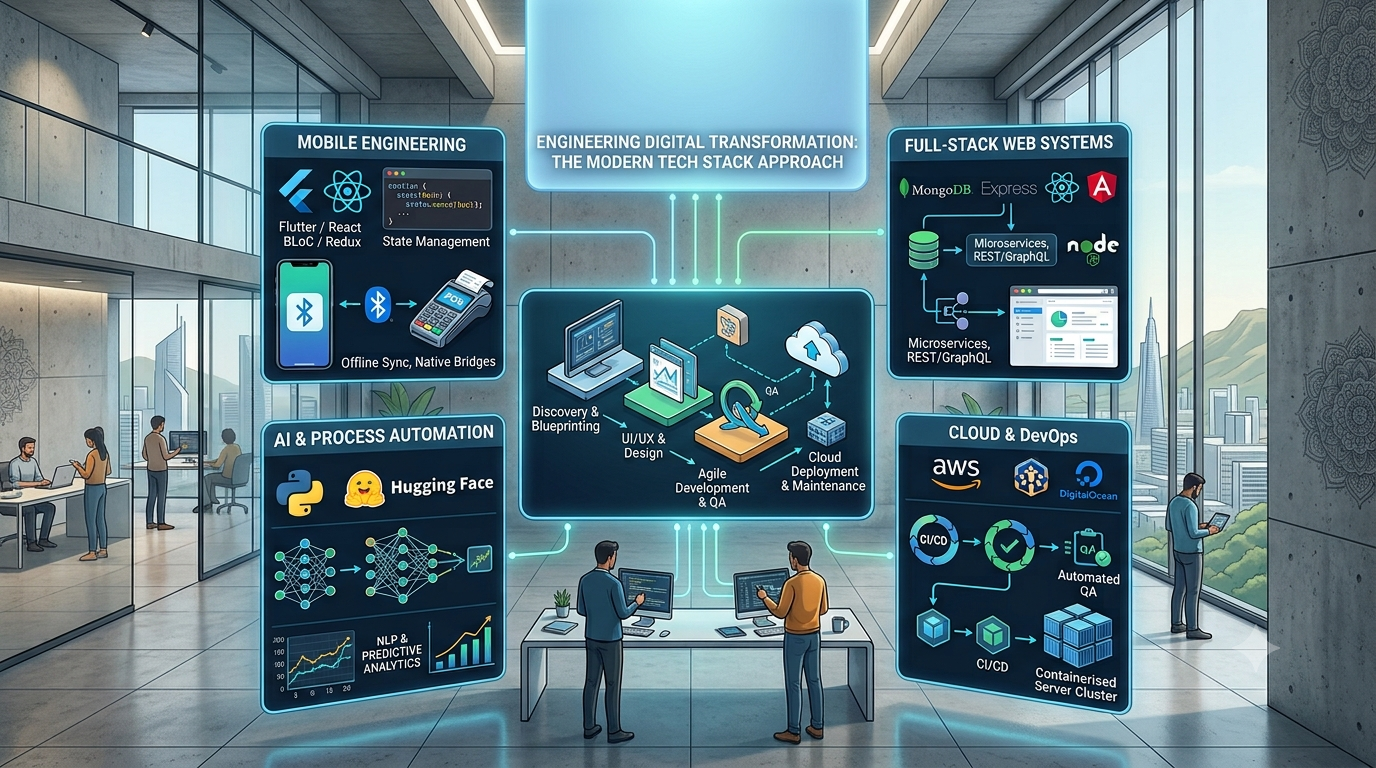
In a market where digital transformation accelerates every fiscal quarter, enterprise success hinges on agile, scalable, and intelligent software architecture. Modern enterprises no longer look for simple outsourcing providers—they seek strategic engineering partners capable of delivering cloud-native platforms, full-stack web applications, custom mobile ecosystems, and integrated AI capabilities.
As an AI-first digital engineering firm, Square Bits specializes in taking complex business ideas and turning them into robust, production-ready systems tailored across e-commerce, POS, healthcare, and fintech sectors.
Technical Capabilities & Service Offerings
| Core Service Pillar | Tech Stack / Tooling | Architectural Focus |
|---|---|---|
| Mobile Engineering | Flutter, React Native, iOS (Swift), Android (Kotlin) | Cross-platform performance, native module optimization, offline sync, low-latency UI. |
| Full-Stack Web Systems | MEAN Stack, MERN Stack, React, Angular, Node.js | Microservices architecture, high-throughput REST/GraphQL APIs, real-time WebSockets. |
| AI & Process Automation | Python, Hugging Face, Custom ML Models | Natural language processing, predictive analytics, intelligent workflow automation. |
| Cloud & DevOps | DigitalOcean, AWS, CI/CD Pipelines | Zero-downtime deployments, auto-scaling, containerized orchestration, secure storage. |
Key Enterprise Architectural Patterns
1. Unified Full-Stack Engineering (MEAN/MERN Solutions)
Building dynamic, high-load web platforms requires unified JavaScript/TypeScript runtimes across client and server environments. By utilizing MongoDB, Express, Angular/React, and Node.js, engineering teams accelerate execution while maintaining strict code reuse and data consistency.
- Real-Time Communication: Integrating WebSocket pipelines for instant updates across admin dashboards, POS systems, and collaborative web platforms.
- Microservices Decoupling: Breaking down monolithic structures into independently deployable services to eliminate single points of failure.
2. Cross-Platform Mobile Applications with Native Reliability
Delivering consistent experiences across iOS and Android while controlling development costs requires modern cross-platform frameworks like Flutter and React Native.
- State Management & Caching: Implementing Redux/Bloc architectures to handle offline data persistence and instant cache rehydration.
- Hardware Interoperability: Writing custom native bridge modules for hardware communication (e.g., thermal printers, Bluetooth peripherals, and payment terminals).
3. Practical AI Engineering & Automation
Moving AI from conceptual research to enterprise utility requires practical integration within existing software workflows.
- Predictive Insights: Deploying lightweight machine learning models to analyze customer behavior, optimize inventory levels, and detect operational anomalies.
- Workflow Automation: Replacing manual data entry and document routing with intelligent NLP pipelines and automated validation filters.
The Agile Development Methodology
┌─────────────────────────────────────────────────────────────┐
│                 SQUARE BITS DELIVERY PIPELINE               │
├─────────────────────────────────────────────────────────────┤
│ Discovery & Blueprinting ──> UI/UX Wireframing & Design     │
│                                       │                     │
│                                       ▼                     │
│ Agile Development Sprints ──> CI/CD & Automated QA Testing │
│                                       │                     │
│                                       ▼                     │
│ Cloud Deployment ──> Ongoing Maintenance & Scaling          │
└─────────────────────────────────────────────────────────────┘
- Discovery & Architecture: Running feasibility research and constructing clear product roadmaps alongside NDA protection.
- User-Centric Design: Creating interactive wireframes and high-fidelity prototypes centered on intuitive UX.
- Agile Iteration: Developing features in short, testable sprints with continuous client reporting and source code ownership transparency.
- Rigorous Quality Assurance: Running automated unit tests, integration benchmarks, and security audits before production release.
Scaling Custom Software Solutions
Whether building custom e-commerce applications, mobile-first logistics tools, or point-of-sale platforms, success depends on software flexibility. Combining modern full-stack development, cloud elasticity, and targeted AI integration gives businesses the technological foundation needed to scale predictably in a competitive digital landscape.
Leave a Reply