Businesses are changing faster than their software.
A company may start with a simple application, add a CRM, connect a payment system, introduce a mobile app, integrate analytics, and eventually adopt AI. Over time, the technology environment can become a collection of different systems that are difficult to maintain and even harder to scale.
This is where composable software architecture can provide a different approach.
Instead of building one large application that does everything, businesses can create software from smaller, reusable, and independently manageable components.
In 2026, composable architecture is becoming increasingly relevant for organizations that want to build digital products that can adapt as their business requirements change.
What Is Composable Software Architecture?
Composable software architecture is an approach where a digital product is assembled from modular components that can be developed, updated, replaced, and integrated independently.
A traditional application might look like:
One Large Application → Database → Users
A composable application can look more like:
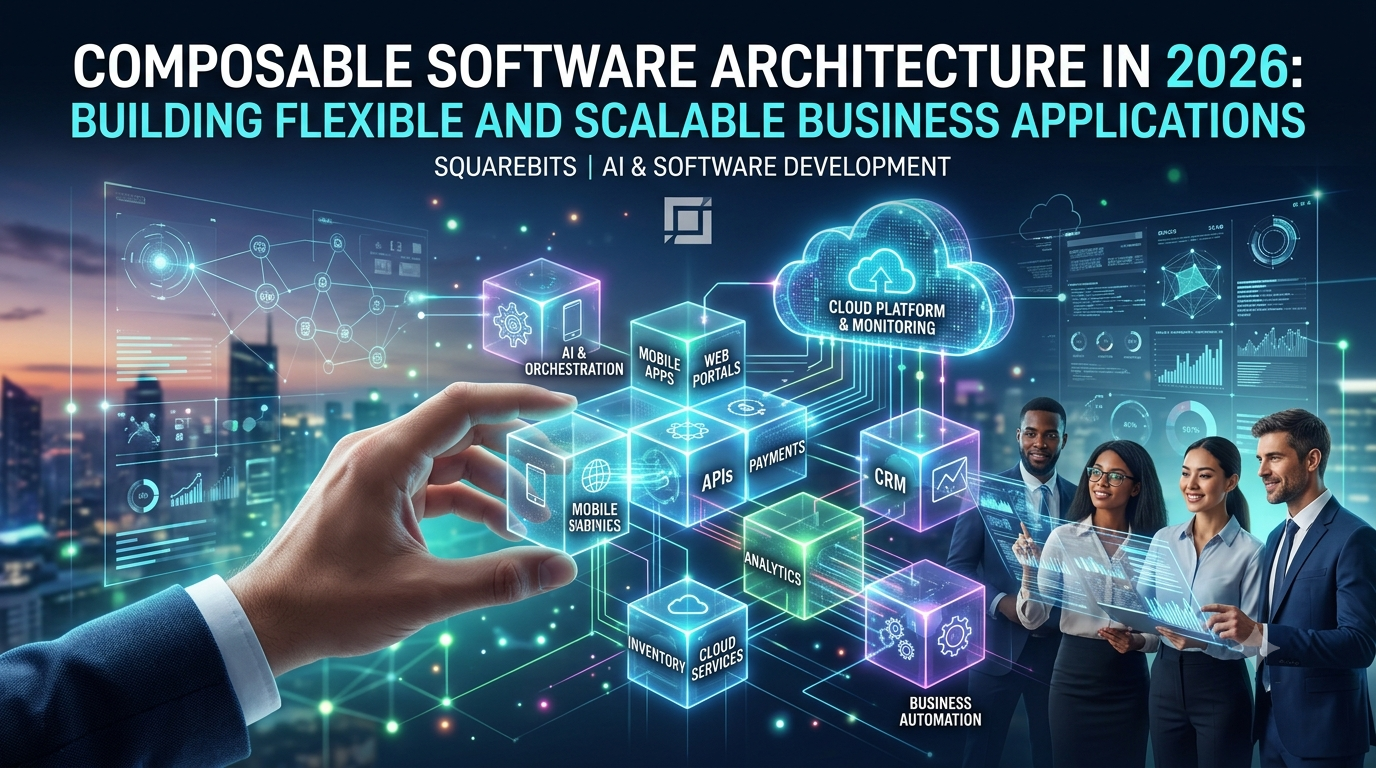
Web App + Mobile App + APIs + AI + Payments + CRM + Analytics + Cloud Services
Each component can perform a specific role while communicating with other components.
For example:
- A payment service handles payments.
- A CRM manages customers.
- An inventory service manages stock.
- An AI service handles intelligent features.
- An analytics platform processes business data.
- A mobile application provides the customer interface.
This approach can make software ecosystems more flexible.
Why Businesses Are Looking at Composable Architecture in 2026
Modern organizations increasingly combine AI, cloud computing, APIs, automation, analytics, mobile applications, and enterprise software. SquareBits’ recent digital-transformation content similarly describes these technologies as interconnected components of a modern digital enterprise.
The challenge is that technology requirements rarely remain fixed.
A business may need to:
- Add a new payment provider
- Launch an Android application
- Build an iOS application
- Introduce AI search
- Connect a CRM
- Replace an old database
- Add a customer portal
- Expand to another market
- Integrate a third-party service
A modular architecture can make these changes easier to manage when the system has been designed with clear boundaries and interfaces.
Traditional Monolithic Software vs. Composable Architecture
Traditional Monolithic Architecture
In a monolithic application, many functions are developed within a single application.
For a business platform, this might include:
- Users
- Products
- Orders
- Payments
- Reports
- Notifications
- Administration
A monolith isn’t automatically bad. For smaller applications, it can be practical and efficient.
However, as an application becomes very large, changing one component can sometimes affect other parts of the system.
Composable Architecture
A composable approach separates major capabilities into independently managed components.
For example:
Customer Service
Order Service
Payment Service
Inventory Service
Notification Service
AI Service
These components can communicate through APIs or other integration mechanisms.
The objective is not to create as many services as possible. The objective is to create useful boundaries that make the system easier to evolve.
Core Principles of Composable Software
1. Modularity
Each major capability should have a clearly defined responsibility.
For example, the payment component should focus on payment-related functionality rather than managing unrelated customer-profile logic.
2. Reusability
A well-designed service can potentially be used by multiple applications.
For example:
Customer API
could support:
- Website
- Android app
- iOS app
- Admin dashboard
- Customer-support portal
3. Interoperability
Different systems should be able to communicate through clearly defined interfaces.
APIs are commonly used to connect applications and services.
4. Replaceability
If a business needs to replace one component, the architecture should minimize the impact on the rest of the system.
For example, a business may replace one analytics provider without rebuilding its entire customer application.
5. Scalability
Individual components can be designed and scaled according to their workload.
A high-volume product-search service may require different infrastructure from a low-volume administrative service.
Composable Architecture and AI
AI makes composable architecture even more interesting.
Modern applications may use several AI capabilities rather than one single model.
For example:
Application
↓
AI Orchestration Layer
↓
LLM + RAG + Recommendation Engine + Computer Vision
↓
Business APIs
↓
CRM + ERP + Database
SquareBits currently lists capabilities including generative AI, AI agents, workflow orchestration, predictive analytics, recommendation engines, computer vision, conversational AI, and AI-powered product design.
A composable architecture can allow businesses to introduce AI capabilities without rebuilding the entire application.
AI as a Modular Business Capability
Imagine an e-commerce platform.
The original application contains:
- Product catalog
- Customer accounts
- Orders
- Payments
Later, the company wants to add AI recommendations.
Instead of rewriting the entire application, an AI recommendation component can be introduced:
Customer Activity → Recommendation Engine → Product API → Mobile/Web App
Later, the company could add:
AI Search
or:
Conversational Shopping Assistant
The architecture can evolve as new requirements appear.
Composable Mobile App Development
Mobile applications can also benefit from modular architecture.
A modern mobile application may contain:
- Authentication
- User profiles
- Payments
- Notifications
- Search
- AI
- Location
- Analytics
- Messaging
Instead of treating the entire application as one tightly connected system, developers can structure functionality into reusable modules and services.
This can be particularly useful when the business needs both:
Android + iOS + Web
SquareBits currently provides mobile development across iOS, Android, Flutter, and React Native, alongside web and backend development.
Composable Architecture for Enterprise Software
Enterprise organizations often have more complicated technology environments.
They may already use:
- ERP
- CRM
- HR software
- Accounting systems
- Inventory systems
- Data warehouses
- Internal applications
- Cloud services
Replacing everything at once can be expensive and disruptive.
A composable approach can allow businesses to modernize incrementally.
For example:
Legacy ERP
↓
Integration/API Layer
↓
Modern Mobile Application
↓
AI Analytics
This approach can allow the organization to introduce new experiences while existing systems continue supporting core operations.
Composable Architecture and Legacy Modernization
Many organizations don’t need to completely replace their legacy systems.
Instead, they can modernize around them.
Consider an older inventory system.
A company may build:
Legacy Inventory System → API Layer → New Web App
Then later:
Legacy Inventory System → API Layer → Mobile App
And eventually:
Inventory Data → Analytics → AI Forecasting
This creates a path toward modernization without necessarily requiring a single large migration project.
SquareBits’ recent enterprise modernization content highlights integration dependencies, security, infrastructure, testing, monitoring, documentation, and maintenance as important considerations when modernizing legacy applications.
Composable Commerce
E-commerce is another strong example.
A modern commerce platform may combine:
- Product catalog
- Search
- Customer accounts
- Payments
- Inventory
- Shipping
- Promotions
- Loyalty
- Analytics
- AI recommendations
Each capability can be treated as a distinct business service.
For example:
Customer → Mobile App → Product API
Customer → Mobile App → Payment API
Customer → Mobile App → Order API
Customer → Mobile App → Loyalty API
This can help businesses create consistent experiences across websites, mobile applications, marketplaces, and physical stores.
Composable POS Systems
Point-of-sale systems can also be designed around modular services.
A modern POS platform might include:
Billing
Handles transactions and receipts.
Inventory
Tracks products and stock.
Customer Management
Maintains customer profiles and loyalty information.
Payments
Connects payment services.
Kitchen Operations
Supports restaurant workflows where applicable.
Analytics
Provides reporting and business insights.
AI
Supports forecasting, recommendations, automation, or intelligent reporting.
Instead of one massive POS application, these capabilities can be organized as connected components.
SquareBits has previously highlighted custom POS, omnichannel commerce, inventory forecasting, loyalty, payments, and analytics as areas where modern POS solutions can be customized around business requirements.
Benefits of Composable Software Architecture
Faster Feature Development
Reusable components can reduce duplicated development work.
Easier Integrations
Well-defined APIs make it easier to connect external systems.
Flexible Technology Choices
Businesses can potentially introduce new technologies without replacing the entire platform.
Better Scalability
Different components can be optimized according to their individual workloads.
Easier Maintenance
Clear separation of responsibilities can make troubleshooting and updates more manageable.
Incremental Modernization
Businesses can modernize one component at a time rather than attempting a complete technology replacement.
Challenges of Composable Architecture
Composable architecture also introduces complexity.
More Components
A system with many components can be harder to understand and manage.
Integration Management
Communication between services needs to be reliable.
Monitoring
Businesses need visibility across multiple systems.
Security
Every API and service can introduce security considerations.
Data Consistency
Distributed systems require careful handling of data synchronization.
DevOps Requirements
Automated deployment, testing, monitoring, and infrastructure management become increasingly important as the number of components grows.
This is why composable architecture should be designed around actual business requirements rather than adopted simply because it is a modern architectural trend.
API Design in Composable Applications
APIs are often the connective layer between components.
A good API strategy should consider:
- Authentication
- Authorization
- Data structures
- Versioning
- Error handling
- Documentation
- Rate limiting
- Monitoring
- Security
For example:
Mobile App → Authentication API
Mobile App → Product API
Mobile App → Order API
Mobile App → Payment API
AI Service → Customer API
Clear API contracts help different components communicate predictably.
Cloud Infrastructure for Composable Applications
Cloud platforms can provide infrastructure for modular systems.
Businesses can combine:
- Containers
- Serverless functions
- Managed databases
- API gateways
- Cloud storage
- Monitoring
- CI/CD pipelines
The architecture should be based on workload and business requirements.
Not every application needs a highly distributed architecture.
For some businesses, a modular monolith may provide many of the benefits of component-based development while keeping operational complexity lower.
Security in Composable Software
Security should be designed across the entire ecosystem.
Important areas include:
Identity
Users and services should have appropriate authentication.
Authorization
Access should be limited according to roles and permissions.
API Security
APIs should be protected against unauthorized access and abuse.
Data Protection
Sensitive data should be appropriately protected during storage and transmission.
Monitoring
Security events should be logged and monitored.
Dependency Management
Third-party libraries and services should be reviewed and maintained.
Composable architecture creates more interfaces, so security needs to be considered across the entire system rather than at only one application boundary.
How to Build a Composable Business Application
A practical development process can include:
Step 1: Map the Business Processes
Identify the major workflows and systems involved.
Step 2: Identify Business Capabilities
Break the platform into logical capabilities such as:
- Customers
- Orders
- Payments
- Inventory
- Analytics
- AI
Step 3: Define System Boundaries
Determine which capabilities should operate independently and which should remain together.
Step 4: Design APIs
Create clear interfaces between applications and services.
Step 5: Build the Core Platform
Develop the most important business capabilities first.
Step 6: Add Integrations
Connect external systems such as CRM, ERP, payment providers, or analytics platforms.
Step 7: Add AI and Automation
Introduce AI capabilities where they provide a measurable business benefit.
Step 8: Test the Ecosystem
Test individual components as well as end-to-end workflows.
Step 9: Monitor and Optimize
Track performance, errors, security events, and system usage.
When Should a Business Use Composable Architecture?
Composable architecture may be useful when a business:
- Operates across multiple platforms
- Needs frequent integrations
- Has complex enterprise workflows
- Plans significant growth
- Needs multiple customer interfaces
- Wants incremental modernization
- Uses AI alongside traditional software
- Needs reusable business services
For a small application with limited requirements, a simpler architecture may be more appropriate.
The architecture should always match the actual business problem.
Why Choose SquareBits for Custom Software Development?
SquareBits describes itself as an AI and software development team serving startups and businesses with scalable applications and platforms. Its current capabilities include AI, mobile and web development, intelligent automation, data and machine learning, computer vision, conversational AI, and AI-powered product design.
For a composable digital product, development may involve several disciplines:
- Product strategy
- UI/UX design
- Mobile development
- Web development
- Backend engineering
- API development
- AI integration
- Cloud architecture
- Data engineering
- Testing
- DevOps
- Maintenance
A technology partner with experience across these areas can help businesses design the complete ecosystem rather than treating each application as a separate project.
The Future of Composable Software
Business technology is becoming increasingly connected.
AI needs access to business data.
Mobile applications need backend services.
Cloud platforms provide scalable infrastructure.
APIs connect different systems.
Analytics turns operational data into insights.
Automation connects software with business workflows.
Composable architecture provides a way to organize these capabilities into a flexible technology ecosystem.
The future may not be about building one enormous application.
It may be about building connected digital capabilities that work together as one business platform.
Conclusion
Composable software architecture in 2026 provides businesses with a practical way to build flexible and scalable digital products.
Instead of creating one tightly coupled application, organizations can design reusable capabilities that communicate through well-defined interfaces.
This can support:
- AI-powered applications
- Enterprise modernization
- Mobile platforms
- E-commerce
- Custom POS
- Cloud applications
- Business automation
- Data and analytics
However, composable architecture should not mean unnecessary complexity.
The best architecture is the one that fits the organization’s business goals, technical requirements, team capabilities, and long-term growth plans.
For businesses building their next digital product, the objective is simple:
Build software that can change as quickly as the business changes.
That is where thoughtful architecture, strong engineering, and the right technology partner can make a difference.
Leave a Reply