Businesses are no longer competing only on products and pricing. Increasingly, they are competing on how quickly they can use technology to make decisions, automate operations, serve customers, and respond to changing market conditions.
In 2026, AI-powered enterprise software development is becoming a major part of digital transformation strategies.
Companies are moving beyond basic automation and adopting intelligent software that can analyze information, connect business systems, assist employees, automate workflows, and provide actionable insights.
For organizations with complex operations, custom enterprise software can provide the flexibility needed to integrate AI into existing business processes.
What Is AI-Powered Enterprise Software?
AI-powered enterprise software combines traditional business applications with artificial intelligence, automation, analytics, and intelligent decision support.
Traditional enterprise software typically follows predefined workflows:
Input → Business Rule → Process → Output
AI-enabled enterprise applications can add another layer:
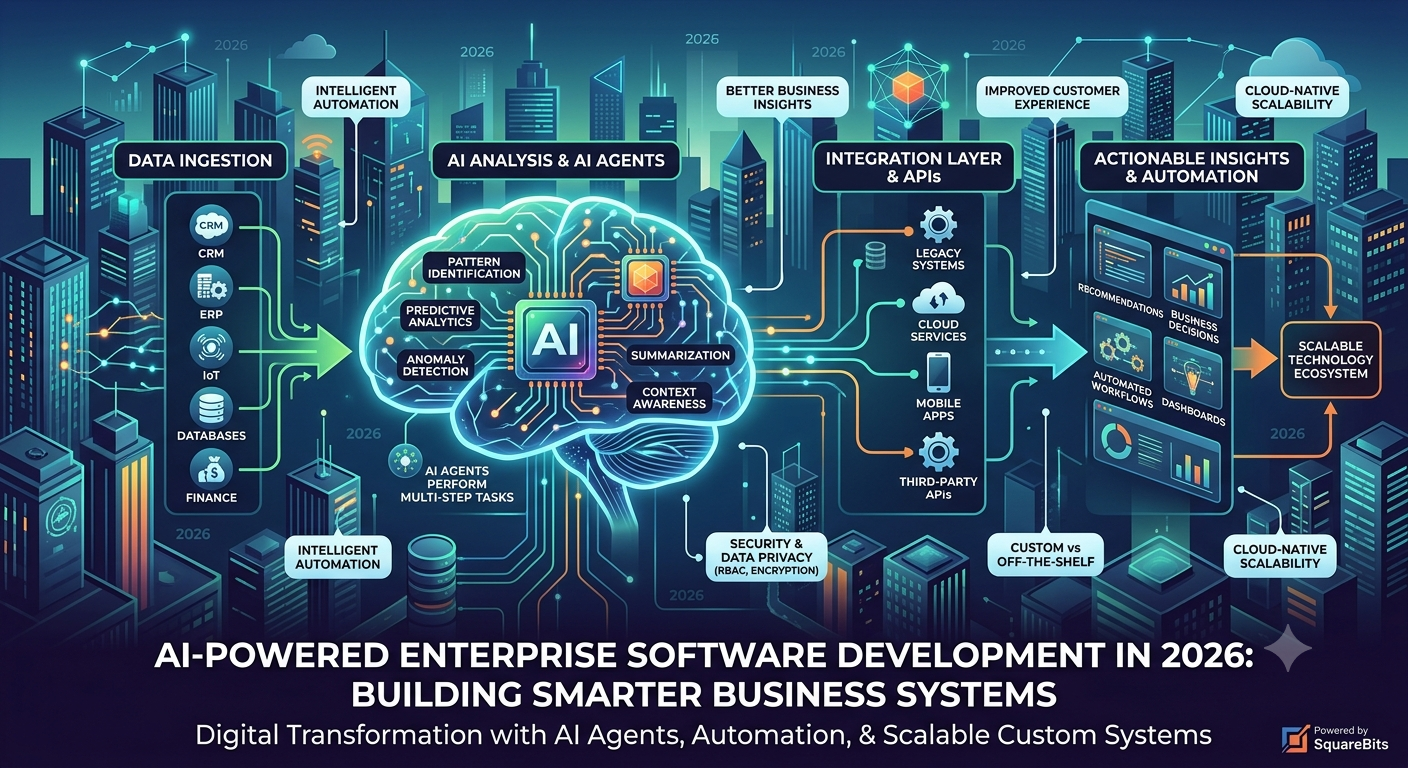
Data → AI Analysis → Recommendation → Decision → Automated Action
This does not mean every business process should be fully automated.
Instead, AI can be introduced where it provides measurable improvements in productivity, accuracy, customer experience, or decision-making.
Why Businesses Are Investing in AI Software
Organizations generate enormous amounts of data through:
- CRM systems
- ERP platforms
- Websites
- Mobile applications
- Customer interactions
- Financial systems
- Sales platforms
- IoT devices
- Internal databases
The challenge is turning this data into useful business information.
AI can help businesses identify patterns, summarize information, automate repetitive processes, and support employees with faster access to relevant information.
Key Benefits of AI-Powered Enterprise Applications
1. Intelligent Automation
Businesses often have repetitive processes that require employees to manually move information between systems.
AI-powered automation can help streamline workflows such as:
- Document processing
- Customer inquiries
- Report generation
- Data classification
- Lead qualification
- Internal approvals
- Information extraction
The goal is to reduce repetitive work while allowing employees to focus on higher-value activities.
2. Better Business Insights
Enterprise applications generate valuable data, but traditional reporting may require employees to manually analyze spreadsheets and dashboards.
AI-powered analytics can help identify:
- Sales trends
- Customer behavior
- Operational issues
- Unusual activity
- Performance changes
- Business opportunities
This can make business intelligence more accessible to non-technical teams.
3. Improved Customer Experience
AI can help businesses provide more personalized digital experiences.
Applications can use customer information to support:
- Personalized recommendations
- Intelligent search
- Automated support
- Customer segmentation
- Faster responses
- Personalized communications
AI should complement customer-service teams rather than simply replace human interaction where human judgment is important.
AI Agents in Enterprise Software
One of the biggest developments in enterprise technology is the rise of AI agents.
Unlike traditional chatbots that primarily respond to questions, AI agents can potentially perform multi-step tasks using connected systems.
For example:
Customer Request → Understand Intent → Retrieve Data → Perform Action → Update System → Notify User
An enterprise AI agent could potentially interact with CRM systems, databases, internal applications, analytics platforms, and other business tools.
This creates opportunities for more intelligent workflow automation.
Custom Enterprise Software vs Off-the-Shelf Platforms
Off-the-shelf software can be an excellent solution for standardized business processes.
However, larger organizations may have workflows that do not fit neatly into generic software.
Custom enterprise software can be designed around:
- Existing business processes
- Internal databases
- Legacy systems
- Customer requirements
- Industry-specific workflows
- Security policies
- Enterprise integrations
- Organizational structures
This flexibility can become particularly valuable when introducing AI into complex environments.
AI Integration With Existing Business Systems
Businesses rarely start from scratch.
They may already use:
- CRM software
- ERP systems
- Accounting platforms
- HR systems
- Payment platforms
- Customer portals
- Mobile applications
- Cloud infrastructure
A successful AI strategy should consider how the new technology will connect with these existing systems.
APIs and integration layers can help AI applications access the right information while maintaining appropriate security controls.
Enterprise AI and Data Security
AI systems can process significant amounts of business information, making security a critical consideration.
Organizations should consider:
- Authentication
- Authorization
- Role-based access
- Data encryption
- API security
- Audit logs
- Data retention
- Access monitoring
- Secure infrastructure
- Privacy requirements
Not every AI system should have access to every company database.
A strong architecture should follow the principle of giving systems only the access they actually need.
AI + Cloud Computing
Cloud platforms provide the infrastructure needed to build and scale modern enterprise applications.
AI-powered applications can use cloud services for:
- Data storage
- Application hosting
- APIs
- Analytics
- Machine learning
- Monitoring
- Security
- Scalability
Cloud architecture also makes it easier to connect multiple business applications through centralized services.
AI + IoT for Enterprise Applications
AI becomes even more powerful when enterprise applications can access real-world device data.
For example:
IoT Device → Sensor Data → Cloud → AI Analysis → Business Application
Potential applications include:
- Predictive maintenance
- Equipment monitoring
- Asset tracking
- Supply-chain visibility
- Smart facilities
- Industrial automation
This creates a bridge between physical operations and enterprise software.
Enterprise Mobile Applications
Employees increasingly need access to business information outside traditional office environments.
Custom enterprise mobile applications can provide access to:
- CRM information
- Sales data
- Inventory
- Work orders
- Customer information
- Reports
- Internal workflows
Adding AI capabilities can help employees search information, summarize data, or complete certain workflows more efficiently.
Common Enterprise AI Use Cases
Different organizations can apply AI differently.
Sales
AI can assist with lead qualification, customer research, sales summaries, and forecasting.
Customer Service
AI can help classify requests, retrieve information, and support customer-service representatives.
Finance
AI can assist with document processing, financial analysis, and anomaly identification.
Human Resources
Enterprise applications can help organize employee information and automate certain administrative workflows.
Operations
AI can analyze operational data and identify potential inefficiencies.
IT
AI-powered tools can assist with monitoring, knowledge management, troubleshooting, and internal support.
How to Start an Enterprise AI Project
Organizations do not need to transform every department at once.
A focused approach can be more effective.
Step 1: Identify a Business Problem
Start with a measurable problem rather than starting with AI technology.
Step 2: Evaluate Existing Data
Determine what information is available and whether it is accurate and accessible.
Step 3: Select the Right AI Use Case
Identify where AI can produce a measurable benefit.
Step 4: Build a Proof of Concept
Test the idea with a controlled implementation.
Step 5: Integrate With Business Systems
Connect the solution to the relevant applications and databases.
Step 6: Measure Results
Track metrics such as:
- Time saved
- Cost reduction
- Productivity
- Customer satisfaction
- Processing speed
- Error reduction
Step 7: Scale
Once the solution demonstrates value, expand it to additional workflows.
Challenges of Enterprise AI Development
AI implementation is not without challenges.
Organizations may need to address:
- Data quality
- Legacy systems
- Integration complexity
- Security
- Privacy
- Model accuracy
- Employee adoption
- Infrastructure costs
- Governance
- AI hallucinations
Successful enterprise AI projects therefore require both AI expertise and strong software engineering.
Why Custom Software Development Matters
AI is only one component of a modern enterprise application.
A production-ready system may require:
- Frontend development
- Backend development
- APIs
- Databases
- Cloud infrastructure
- AI integration
- Security
- Mobile applications
- Analytics
- Third-party integrations
Custom software development allows these components to be designed as one connected ecosystem.
The Future of Enterprise Software
Enterprise software is moving toward systems that are more intelligent, connected, and automated.
The next generation of business applications will increasingly combine:
AI + Cloud + Data + Automation + Mobile + APIs + IoT
Instead of simply storing information, enterprise applications will increasingly help employees understand information and take action.
The objective is not to automate everything.
It is to build technology that helps people and organizations work faster, make better decisions, and operate more efficiently.
How SquareBits Helps Businesses Build Digital Solutions
SquareBits focuses on custom software and technology solutions designed around business requirements.
A modern enterprise solution can combine AI, web applications, mobile applications, cloud platforms, APIs, databases, automation, and business intelligence into a connected technology ecosystem.
For organizations planning digital transformation in 2026, the right technology partner can help turn complex business requirements into scalable software solutions.
Final Thoughts
AI-powered enterprise software is becoming an important part of modern digital transformation.
Organizations that successfully combine AI with strong software architecture can create applications that do more than automate repetitive tasks. They can help employees access information, understand business data, streamline workflows, and make better decisions.
The key is to start with a real business problem, build a focused solution, measure its impact, and scale intelligently.
Looking to build custom enterprise software with AI?
SquareBits can help businesses design and develop scalable digital solutions combining AI, automation, cloud technology, enterprise software, mobile applications, APIs, and modern data platforms.
Leave a Reply