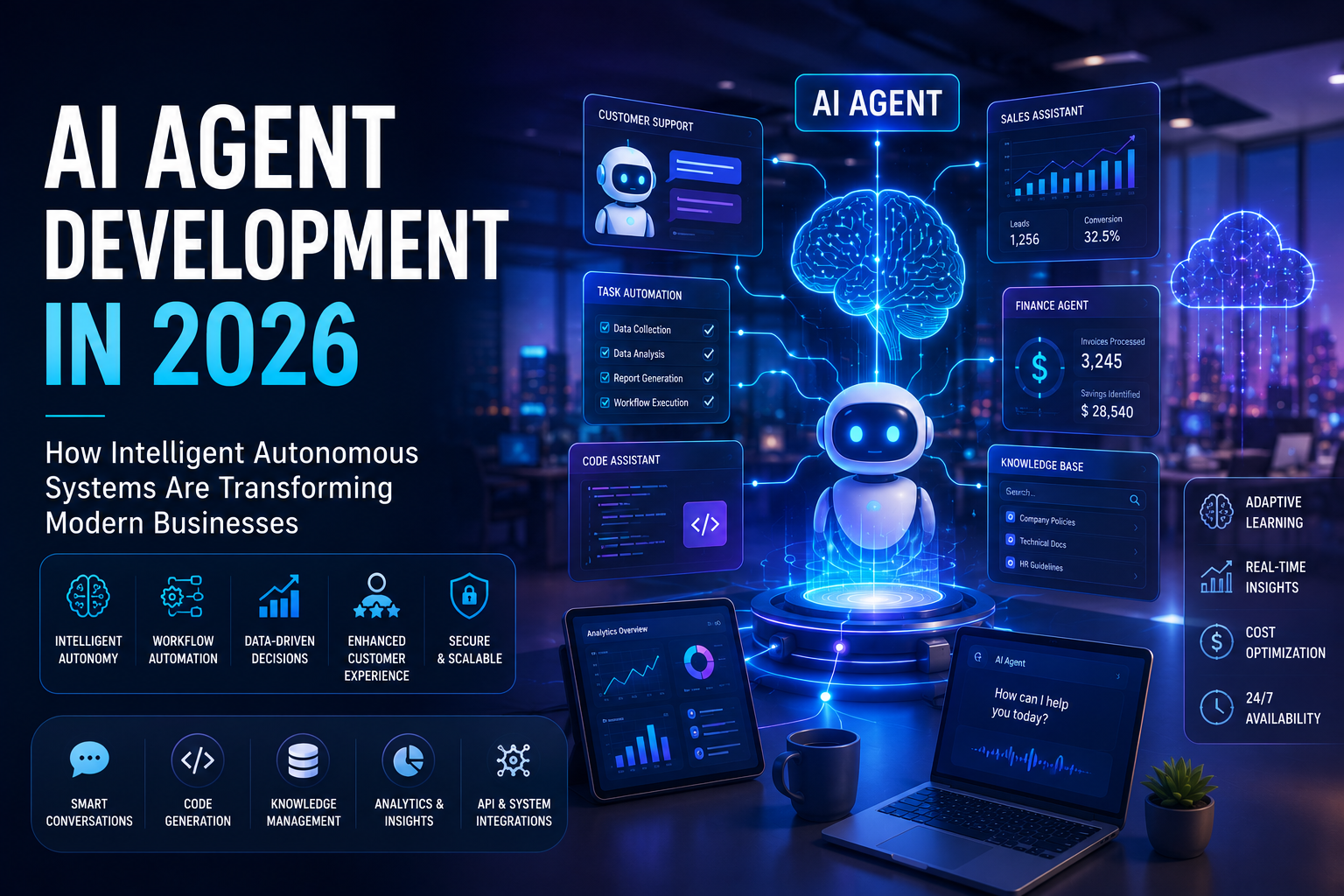
Artificial Intelligence has moved beyond simple chatbots and automation tools. In 2026, businesses are embracing AI agents—intelligent software systems capable of reasoning, making decisions, learning from data, and completing complex tasks with minimal human intervention.
From customer support and software development to sales, finance, healthcare, and operations, AI agents are becoming the digital workforce that enables organizations to work faster, smarter, and more efficiently.
At SquareBits, we design and develop custom AI agents that help businesses automate workflows, improve productivity, reduce operational costs, and deliver exceptional customer experiences.
What Is an AI Agent?
An AI agent is an intelligent software system that can perceive information, analyze data, make decisions, execute actions, and continuously improve based on outcomes.
Unlike traditional automation software that follows predefined rules, AI agents use advanced technologies such as:
- Large Language Models (LLMs)
- Machine Learning (ML)
- Natural Language Processing (NLP)
- Computer Vision
- Predictive Analytics
- Knowledge Retrieval
- Workflow Automation
These capabilities allow AI agents to solve complex business problems autonomously.
How AI Agents Work
Modern AI agents operate through several coordinated steps:
1. Data Collection
The agent gathers information from multiple sources, including:
- Business applications
- APIs
- Databases
- Documents
- Emails
- IoT devices
- Customer interactions
2. Context Understanding
Using AI models, the agent interprets requests, understands user intent, and identifies the most relevant information.
3. Decision Making
The AI evaluates available options, applies business rules, and determines the best course of action.
4. Action Execution
Depending on the workflow, the AI agent can:
- Respond to customers
- Generate reports
- Schedule meetings
- Update CRM systems
- Process invoices
- Analyze business data
- Trigger automation workflows
5. Continuous Learning
AI agents improve over time by learning from feedback, historical interactions, and operational outcomes.
Types of AI Agents
Customer Support Agents
Provide instant responses, resolve common issues, and escalate complex cases when needed.
Sales AI Agents
Help qualify leads, recommend products, schedule meetings, and automate follow-up communication.
Finance AI Agents
Automate invoice processing, expense management, financial reporting, and fraud detection.
HR AI Agents
Support recruitment, employee onboarding, document management, and internal knowledge sharing.
Software Development Agents
Assist developers by generating code, reviewing pull requests, creating documentation, and identifying bugs.
Operations AI Agents
Automate repetitive business processes, monitor performance, and optimize resource allocation.
Key Benefits of AI Agent Development
Increased Productivity
AI agents perform repetitive tasks continuously, allowing employees to focus on strategic work.
Faster Decision Making
Real-time analytics enable quicker responses to business opportunities and operational challenges.
Lower Operational Costs
Automation reduces manual effort, minimizes errors, and improves efficiency.
Enhanced Customer Experience
AI agents provide personalized, consistent, and 24/7 customer support across multiple channels.
Scalability
AI systems can handle increasing workloads without requiring proportional staffing increases.
Data-Driven Insights
AI agents analyze large volumes of business data to identify trends, risks, and growth opportunities.
Industries Using AI Agents
AI agents are transforming virtually every industry, including:
- Healthcare
- Finance
- Retail
- Manufacturing
- Logistics
- Hospitality
- Real Estate
- Legal Services
- Education
- Insurance
- Telecommunications
- SaaS Platforms
Technologies Behind AI Agents
Modern AI agent platforms combine:
- Generative AI
- Large Language Models (LLMs)
- Retrieval-Augmented Generation (RAG)
- Machine Learning
- Natural Language Processing
- Vector Databases
- Knowledge Graphs
- Cloud Computing
- API Integrations
- Workflow Automation Engines
Together, these technologies create intelligent systems capable of understanding context, retrieving information, and taking meaningful actions.
Why Choose SquareBits?
At SquareBits, we build enterprise-grade AI agents that integrate seamlessly with your existing systems and business workflows.
Our AI development services include:
- Custom AI Agent Development
- Enterprise AI Solutions
- Workflow Automation
- AI Chatbots & Virtual Assistants
- LLM Integration
- RAG-Based Knowledge Systems
- AI API Development
- Business Process Automation
- AI Strategy & Consulting
- Ongoing AI Optimization & Support
We create secure, scalable, and intelligent AI solutions that help businesses accelerate innovation and achieve measurable results.
The Future of AI Agents
The next generation of AI agents will offer:
- Multi-agent collaboration
- Autonomous decision-making
- Voice-first interactions
- AI-powered software engineering
- Predictive business optimization
- Hyper-personalized customer experiences
- Digital workforce management
- Self-improving enterprise systems
Organizations that adopt AI agents today will gain a significant competitive advantage as autonomous technologies continue to evolve.
Conclusion
AI agents are redefining how businesses operate by combining intelligence, automation, and adaptability into a single solution. They enable organizations to automate repetitive tasks, improve customer engagement, accelerate decision-making, and scale operations efficiently.
Whether you’re looking to enhance customer service, optimize internal workflows, or build an intelligent digital workforce, custom AI agent development provides the flexibility and innovation required for long-term success.
Ready to build intelligent AI agents for your business?
Partner with SquareBits to develop secure, scalable, and enterprise-ready AI solutions that drive productivity, innovation, and sustainable growth.
Frequently Asked Questions (FAQs)
What is an AI agent?
An AI agent is an intelligent software system that can understand information, make decisions, perform tasks, and improve over time with minimal human intervention.
How are AI agents different from chatbots?
Traditional chatbots mainly respond to predefined questions, while AI agents can reason, plan, integrate with business systems, execute workflows, and make context-aware decisions.
Which businesses benefit from AI agents?
Businesses across healthcare, finance, retail, logistics, manufacturing, hospitality, education, and SaaS can use AI agents to automate operations and improve efficiency.
Can AI agents integrate with existing software?
Yes. AI agents can integrate with CRMs, ERPs, payment systems, cloud platforms, databases, APIs, and other enterprise applications.
Are AI agents secure for enterprise use?
When built using enterprise-grade security practices, AI agents support secure authentication, encrypted communication, role-based access controls, audit logs, and compliance with organizational policies.
Leave a Reply