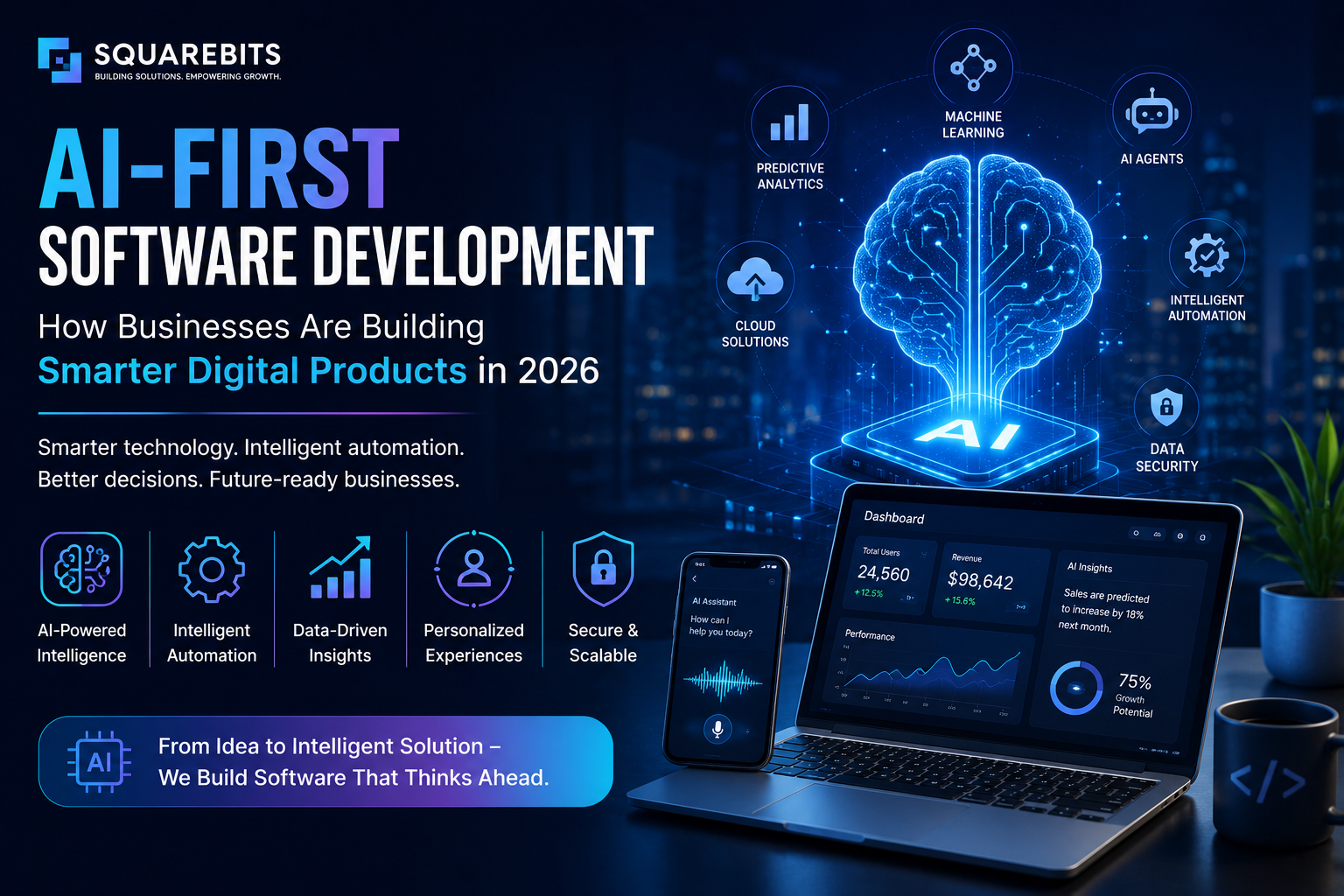
Software development is entering a new era.
For many years, businesses built digital products by adding new technologies as requirements changed. Today, artificial intelligence is influencing software strategy from the beginning.
In 2026, businesses are moving toward AI-first software development—an approach where AI capabilities, intelligent automation, data-driven insights, and personalized experiences are considered during product planning rather than added after the application is built.
AI-first development does not mean every application needs an AI chatbot. It means businesses evaluate where AI can create real value across customer experiences, internal operations, product features, and software development workflows.
From intelligent mobile applications to automated business platforms, AI is helping companies build smarter, faster, and more adaptable digital products.
What Is AI-First Software Development?
AI-first software development is an approach that considers artificial intelligence as a core part of the product strategy and application architecture.
An AI-first product may use AI to:
- Automate repetitive tasks
- Analyze business data
- Personalize user experiences
- Generate intelligent recommendations
- Improve customer support
- Predict future trends
- Support faster decision-making
- Create adaptive workflows
The goal is not to add AI everywhere. The goal is to identify where AI can solve a real problem or improve a user experience.
For example, a traditional business dashboard may display sales data. An AI-powered dashboard can identify important trends, explain changes, and highlight possible opportunities.
Why Businesses Are Adopting AI-First Strategies
Customer expectations are changing.
Users want applications that are:
- Faster
- More personalized
- Easier to use
- Available when needed
- Capable of providing relevant information
Businesses also want technology that can improve efficiency and support growth.
AI-first applications can help organizations:
Improve Productivity
AI can automate routine activities such as:
- Data entry
- Document processing
- Report generation
- Customer request classification
- Content organization
- Workflow routing
This can reduce manual work and allow teams to focus on higher-value activities.
Create Better Customer Experiences
AI can analyze user behavior and provide more relevant experiences.
Examples include:
- Personalized product recommendations
- Smart search
- AI-powered support
- Customized content
- Intelligent onboarding
Support Better Business Decisions
Businesses generate large amounts of information.
AI can help identify:
- Customer trends
- Sales patterns
- Operational risks
- Growth opportunities
- Unusual activity
Instead of reviewing multiple reports, teams can receive useful insights through intelligent dashboards.
Top AI-First Software Development Trends in 2026
1. AI Agents for Business Workflows
AI agents are moving beyond simple question-and-answer experiences.
An AI agent can be designed to:
- Understand a business goal
- Review relevant information
- Use connected tools
- Complete approved steps
- Provide a summary
For example, an AI customer service agent may review an order, identify a delivery issue, create a support request, and send an update.
Human oversight remains important, especially when AI affects customers, finances, security, or important business decisions.
2. AI-Powered Mobile Applications
Mobile applications are becoming more intelligent.
AI features may include:
- Personalized recommendations
- Voice interaction
- Smart search
- Image recognition
- Predictive notifications
- AI assistants
AI can help mobile apps adapt to user needs and provide more relevant experiences.
3. Intelligent Automation
Traditional automation follows predefined rules.
AI-powered automation can understand unstructured information and support more complex workflows.
Businesses are using intelligent automation for:
- Customer support
- Document processing
- Sales operations
- Employee workflows
- Data analysis
- Business reporting
The most effective systems combine AI capabilities with clear business rules and human review.
4. AI-Enhanced Software Development
AI is also changing how software is created.
Development teams can use AI to support:
- Code generation
- Documentation
- Testing
- Debugging
- Code reviews
- Software modernization
AI can speed up repetitive development tasks, but developers remain responsible for architecture, security, quality, and business requirements.
5. AI-Native User Experiences
AI-native applications are designed around intelligent interaction.
Instead of navigating many menus, users may:
- Ask questions in natural language
- Request reports through chat
- Use voice commands
- Receive personalized recommendations
- Complete tasks with AI assistance
This can make complex software easier to use.
6. AI and Predictive Analytics
Predictive analytics uses historical information to identify possible future patterns.
Businesses can use predictive capabilities for:
- Sales forecasting
- Inventory planning
- Customer retention
- Demand forecasting
- Risk analysis
Predictions should be monitored and evaluated because results depend on data quality and changing business conditions.
7. Responsible AI and Human Oversight
As AI becomes more important, businesses are focusing on:
- Transparency
- Privacy
- Security
- Fairness
- Accountability
- Human review
Responsible AI should be included throughout product planning, development, testing, deployment, and ongoing monitoring.
How to Build an AI-First Digital Product
Step 1: Identify the Business Problem
Start with a clear goal.
Ask:
- What problem are we solving?
- Who will use the application?
- Which tasks can AI improve?
- How will success be measured?
A clear use case helps avoid unnecessary AI features.
Step 2: Create an AI Product Strategy
The strategy should define:
- AI capabilities
- Data requirements
- User workflows
- Security needs
- Technical architecture
- Success metrics
Step 3: Design the User Experience
AI should make the application easier to use.
Users should understand:
- What the AI can do
- When results are generated by AI
- How to provide feedback
- When human review is available
Step 4: Build the Software Architecture
An AI-first architecture may include:
- Mobile or web applications
- Cloud infrastructure
- AI models
- APIs
- Databases
- Business integrations
- Security systems
The architecture should support future growth and new features.
Step 5: Develop and Integrate AI Features
Developers build the application and connect AI capabilities with business workflows.
Possible features include:
- AI assistants
- Smart search
- Recommendations
- Automation
- Predictive analytics
Step 6: Test AI Performance
Testing should evaluate:
- Accuracy
- Reliability
- Security
- User experience
- Performance
- Edge cases
Step 7: Launch and Improve
AI products should be monitored after launch.
Businesses can use feedback and performance data to improve the application.
Benefits of Custom AI Software Development
Custom AI software can be designed around a company’s specific needs.
Benefits may include:
- Better workflow integration
- Industry-specific features
- Greater flexibility
- Improved scalability
- Custom user experiences
- Stronger control over data
A custom solution can evolve as the business grows.
Industries Using AI-First Software
Healthcare
AI can support:
- Patient engagement
- Appointment automation
- Document analysis
- Healthcare workflows
Retail
AI can help with:
- Product recommendations
- Inventory forecasting
- Customer engagement
- Sales analysis
Finance
AI can support:
- Fraud detection
- Customer service
- Risk analysis
- Financial insights
Education
AI-powered platforms can provide:
- Personalized learning
- AI tutoring
- Progress tracking
- Adaptive content
Logistics
AI can support:
- Route planning
- Demand forecasting
- Asset monitoring
- Operational analytics
Build AI-First Digital Products with SquareBits
At SquareBits, we help businesses transform ideas into intelligent, scalable, and user-focused digital solutions.
Our services include:
- AI application development
- Custom software development
- Mobile app development
- Web application development
- AI agent development
- AI automation
- SaaS development
- UI and UX design
- Cloud solutions
- Software modernization
- Product development and support
Whether you are building a new AI-powered product, improving an existing application, or automating business workflows, our team can help create technology aligned with your goals.
Conclusion
AI-first software development is changing how businesses plan and build digital products.
The future is not about adding AI to every feature. It is about using AI where it improves customer experiences, supports employees, automates valuable work, and creates measurable business outcomes.
Businesses that combine clear product strategy, strong software architecture, responsible AI practices, and user-focused design can build digital products that are ready for long-term growth.
Ready to build a smarter digital product? Connect with SquareBits and turn your idea into an intelligent, scalable solution.
Leave a Reply