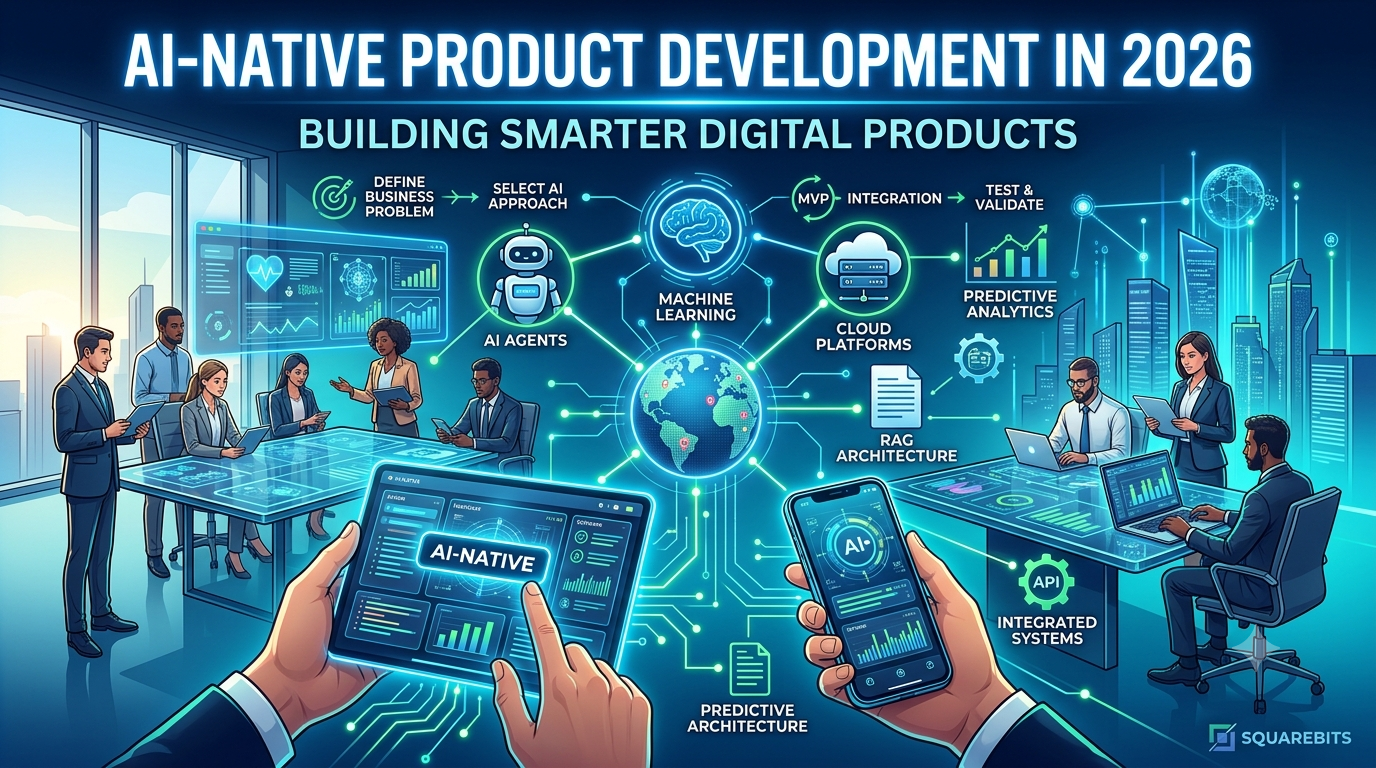
Businesses are no longer building software simply to digitize existing processes. In 2026, organizations are increasingly looking at software as an intelligent business layer that can understand information, automate workflows, personalize experiences, and support better decisions.
This shift is creating a new approach to AI-native product development.
Instead of adding AI to an existing application as an afterthought, businesses can design AI capabilities into the product architecture from the beginning. This approach can combine artificial intelligence, automation, cloud technology, APIs, data platforms, mobile applications, and modern user experiences.
For startups and enterprises, the opportunity is to create digital products that are not only functional today but also capable of evolving as business requirements and AI technologies change.
What Is AI-Native Product Development?
AI-native product development means designing a digital product with artificial intelligence as a fundamental part of its functionality and architecture.
A traditional application might follow:
User → Application → Database → Result
An AI-enabled product could follow:
User → AI Interface → Business Logic → Data → AI Processing → Action / Recommendation
Depending on the use case, AI can support:
- Intelligent search
- Natural-language interfaces
- Recommendations
- Predictive analytics
- Workflow automation
- Document processing
- Conversational experiences
- AI agents
- Personalization
- Decision support
The goal is not to use AI everywhere. The goal is to use it where it creates meaningful value.
Why AI-Native Applications Are Growing
Modern businesses generate enormous amounts of information through applications, transactions, customer interactions, devices, and internal systems.
Traditional software can store and process this information, but AI can add another layer of intelligence.
For example, an enterprise platform could allow an employee to ask:
“Show me the customers whose orders have declined during the last three months.”
Instead of manually searching multiple dashboards, an AI-powered interface could interpret the request, retrieve relevant data, and present the results through the application’s approved data and access controls.
This changes the way people interact with business software.
AI Can Transform the User Experience
The traditional application interface relies heavily on menus, buttons, filters, and forms.
AI introduces another interaction model: conversation.
Users can potentially interact with an application using:
- Natural language
- Voice
- Images
- Documents
- Conversational commands
For example, an e-commerce application could allow customers to describe what they need rather than manually applying multiple filters.
A business application could allow employees to ask questions about company data using natural language.
This can make complex software easier to navigate when the underlying AI and data systems are properly designed.
AI Agents and Business Workflows
AI agents are becoming an important part of modern software development.
An AI agent can be designed to perform a sequence of tasks using defined tools, data sources, APIs, and business rules.
For example:
Customer Request → AI Agent → Customer Data → Business Rules → API → Action → Confirmation
Potential enterprise use cases include:
- Customer support
- Lead qualification
- Internal IT assistance
- Document processing
- Research
- Reporting
- Scheduling
- Workflow automation
However, agentic systems should operate within carefully defined permissions. Businesses need to determine which actions an AI system can perform automatically and which require human approval.
AI + Custom Software Development
AI becomes more useful when it is connected to the software that already runs a business.
A company may have:
- CRM systems
- ERP platforms
- Payment systems
- Databases
- Customer portals
- Mobile applications
- Internal dashboards
Rather than replacing everything, AI can be integrated with these systems through APIs and controlled data-access layers.
For example:
Email → AI extracts information → Business rules validate it → API updates CRM → Automated response
This type of intelligent automation can reduce repetitive work while keeping existing business systems at the center of operations.
The Importance of Business Data
AI applications are only as useful as the information they can reliably access.
Enterprise AI products may need to work with:
- Structured databases
- PDFs
- Documents
- Product catalogs
- Customer records
- Knowledge bases
- APIs
- Business analytics
Technologies such as Retrieval-Augmented Generation (RAG) can allow AI systems to retrieve relevant information from approved sources before generating responses.
This can be particularly useful for enterprise knowledge assistants and customer-support applications.
AI Product Development Across Industries
AI-native applications can be developed for many industries.
Healthcare
Potential applications include:
- Patient engagement
- Medical information assistants
- Appointment workflows
- Document analysis
- Healthcare administration
Healthcare applications require careful attention to privacy, security, and applicable regulatory requirements.
Retail and E-Commerce
AI can support:
- Product recommendations
- Intelligent search
- Personalized experiences
- Customer support
- Inventory insights
- Sales forecasting
Finance
Potential applications include:
- Document processing
- Customer-service automation
- Risk analysis
- Financial insights
- Fraud detection
Financial applications require appropriate security, compliance, and human oversight.
Food and Hospitality
AI can be integrated into:
- POS systems
- Restaurant analytics
- Demand forecasting
- Customer engagement
- Inventory management
- Personalized offers
IoT and Connected Products
AI can analyze data from connected devices to support:
- Anomaly detection
- Predictive maintenance
- Device analytics
- Intelligent automation
- Operational monitoring
This creates an architecture combining IoT + cloud + AI + mobile applications.
Building Scalable AI Software
An AI product needs more than a good model.
The underlying architecture should consider:
Scalability
The application should be able to handle increasing users, transactions, and AI workloads.
Security
Access controls, authentication, authorization, encryption, and API security should be incorporated into the architecture.
Data Management
Businesses need appropriate systems for storing, retrieving, processing, and governing data.
API Architecture
APIs allow AI applications to communicate with existing enterprise systems and external services.
Monitoring
Production AI applications should be monitored for performance, reliability, security, cost, and response quality.
AI App Development vs. Traditional Software Development
AI products introduce additional engineering considerations.
| Area | Traditional Software | AI-Native Software |
|---|---|---|
| User interaction | Forms, menus, screens | Screens + natural language + AI |
| Logic | Mostly deterministic | Deterministic + AI-driven |
| Data | Application databases | Databases + knowledge sources |
| Automation | Rule-based | Rules + AI |
| Personalization | Predefined rules | Data-driven personalization |
| Testing | Functional testing | Functional + AI behavior testing |
| Monitoring | System performance | System + model behavior |
This does not mean traditional software engineering becomes less important. Instead, AI engineering adds another layer to the product-development process.
AI Product Development Process
A practical AI product-development process can follow several stages.
1. Define the Business Problem
Start with the problem rather than the technology.
Determine:
- What needs improvement?
- Who will use the product?
- What data is available?
- What should AI actually do?
2. Select the AI Approach
Depending on the use case, the solution may use:
- Generative AI
- Machine learning
- Computer vision
- Natural language processing
- RAG
- AI agents
- Predictive analytics
3. Design the Product Architecture
Define the relationship between:
Frontend + Backend + AI + Data + APIs + Security
4. Build the MVP
Start with the most valuable AI capability rather than attempting to automate the entire business immediately.
5. Integrate Business Systems
Connect the product with relevant databases, APIs, CRM systems, ERP platforms, payment systems, or other enterprise tools.
6. Test and Validate
Testing should evaluate:
- Application functionality
- AI response quality
- Security
- Performance
- Data accuracy
- Failure scenarios
- Access controls
- Cost
7. Deploy and Improve
AI products require continuous improvement.
User feedback, new data, changing business requirements, model updates, and application performance should all inform future iterations.
Why Human-Centered AI Still Matters
AI should enhance the capabilities of people rather than simply add automation for its own sake.
A well-designed enterprise application can allow AI to handle repetitive tasks while employees remain responsible for decisions that require context, judgment, or approval.
This creates a human + AI workflow.
For example:
AI analyzes → Employee reviews → Business system executes
This approach can provide a balance between automation and human oversight.
Building AI Products With SquareBits
SquareBits describes its focus as combining software development and digital transformation with AI-driven solutions. Its current capabilities include generative AI, AI agents, intelligent automation, machine learning, computer vision, conversational AI, and AI-powered product design.
The company also provides mobile and web development, custom software solutions, IoT development, and other technology services, allowing AI capabilities to be integrated into broader digital products rather than treated as isolated features.
For businesses, an AI product-development engagement can follow a practical path:
Business Challenge → AI Strategy → Product Architecture → MVP → Integration → Testing → Deployment → Continuous Improvement
The Future of AI-Native Products
The next generation of software is likely to become increasingly intelligent and context-aware.
Applications will continue evolving toward:
- AI-native interfaces
- AI agents
- Multimodal experiences
- Intelligent automation
- Personalized software
- AI-powered analytics
- Voice-driven applications
- Connected AI and IoT platforms
- Enterprise AI assistants
The biggest opportunity is not simply adding more AI features. It is creating products where AI solves meaningful problems within a reliable software architecture.
Conclusion
AI-native product development in 2026 represents a shift from traditional software toward intelligent digital products that can understand information, automate workflows, and deliver more personalized experiences.
Businesses can combine AI, custom software, cloud platforms, APIs, data engineering, mobile applications, and automation to build products around their specific requirements.
The right starting point is not the latest AI model. It is a clear understanding of the business problem, the users, the available data, and the outcome the product needs to deliver.
For startups and enterprises looking to turn an idea into a scalable AI-powered product, the combination of strong software engineering and practical AI strategy can provide the foundation for long-term digital growth.
Leave a Reply