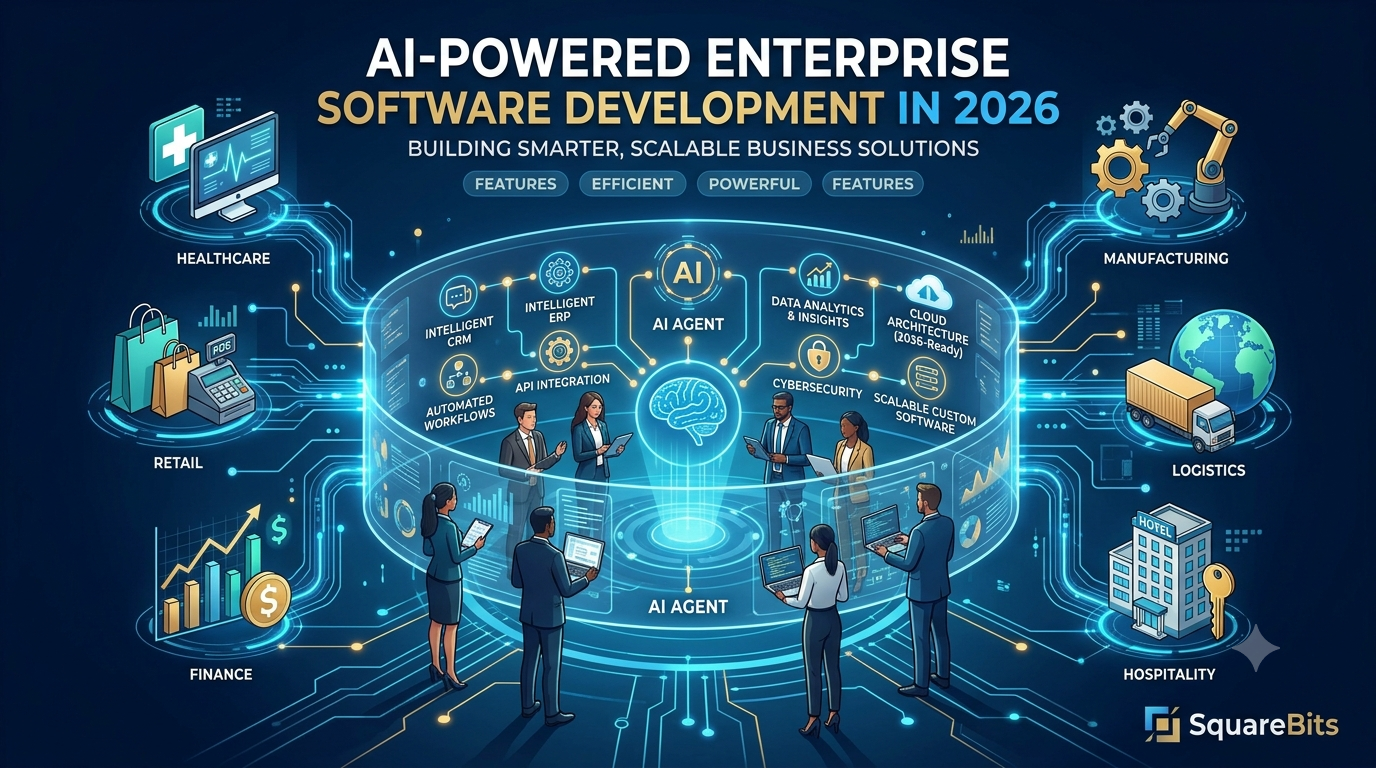
Enterprise software is entering a new phase.
Businesses are no longer looking for software that simply stores information, manages workflows, or connects employees. In 2026, organizations are increasingly looking for intelligent software systems that can analyze data, automate processes, assist employees, improve customer experiences, and support faster business decisions.
Artificial intelligence, cloud computing, APIs, automation, data analytics, cybersecurity, and modern application architectures are becoming core components of enterprise technology strategies.
For businesses planning their next digital product or upgrading legacy applications, the opportunity is significant: build software that does more than operate—it understands, adapts, and creates measurable business value.
SquareBits helps startups, growing businesses, and enterprises transform these opportunities into scalable digital products through AI application development, custom software development, mobile and web development, enterprise solutions, and digital transformation.
What Is AI-Powered Enterprise Software?
AI-powered enterprise software combines traditional business applications with artificial intelligence and automation.
Instead of following only predefined rules, intelligent applications can analyze information, identify patterns, generate insights, and support business workflows.
For example:
Customer Data → AI Analysis → Business Insight → Automated Action → Measurable Result
An enterprise application could use AI to:
- Analyze customer behavior
- Predict demand
- Automate document processing
- Summarize large datasets
- Detect unusual transactions
- Recommend products or services
- Assist customer support teams
- Automate repetitive workflows
- Generate business reports
- Support employee decision-making
The goal isn’t to add AI simply because it is trending.
The goal is to use AI where it can solve a real business problem.
Why AI-Powered Software Development Matters in 2026
Enterprise technology is becoming increasingly complex.
Organizations may operate with a combination of:
- Legacy applications
- CRM platforms
- ERP systems
- Mobile applications
- E-commerce platforms
- Payment systems
- Cloud infrastructure
- Data warehouses
- IoT devices
- Analytics platforms
When these systems operate independently, businesses can end up with disconnected data and inefficient workflows.
AI can become an intelligence layer across these systems.
For example:
CRM + ERP + Customer Data + Analytics + AI + Automation
This connected approach can help organizations move from reactive operations toward more predictive and automated processes.
1. AI Agents for Enterprise Workflows
One of the major developments in enterprise software is the growth of AI-powered agents.
Traditional automation generally follows predefined rules:
IF condition → THEN action
AI-enabled workflows can interpret information and determine the next appropriate step within predefined permissions.
For example:
Incoming Invoice → AI Reads Document → Extracts Data → Validates Information → Checks ERP → Flags Exceptions → Sends for Approval
This can reduce manual data entry and allow employees to focus on exceptions and higher-value tasks.
Enterprise AI agents should still operate with appropriate security, permissions, monitoring, and human oversight.
2. Intelligent Business Applications
The next generation of enterprise applications will increasingly include intelligence as a core capability.
Examples include:
Intelligent CRM
AI can help sales teams identify promising leads, summarize customer interactions, and recommend follow-up actions.
Intelligent ERP
AI can assist with forecasting, inventory analysis, financial reporting, and operational planning.
Intelligent Customer Portals
AI assistants can help customers find information, complete processes, and receive personalized recommendations.
Intelligent Analytics
Instead of requiring users to manually analyze dashboards, AI can identify important changes and explain potential business implications.
This changes enterprise software from a passive tool into a more proactive business assistant.
3. AI + Cloud: The New Enterprise Architecture
AI applications require scalable infrastructure.
Cloud platforms can provide the computing resources, storage, APIs, monitoring, and deployment capabilities needed to operate modern AI-enabled applications.
A modern architecture may include:
Frontend → API Layer → Business Logic → AI Services → Data Platform → Cloud Infrastructure
This architecture allows organizations to scale individual components as requirements change.
Cloud modernization is particularly important for enterprises working with legacy infrastructure because AI adoption can expose limitations in outdated architectures.
4. API Integration Will Become Even More Important
Enterprise software rarely operates independently.
A modern business application may need to connect with:
- CRM systems
- ERP platforms
- Payment gateways
- E-commerce platforms
- Marketing tools
- AI services
- Analytics platforms
- Mobile applications
- IoT platforms
- Internal databases
APIs provide the foundation for these integrations.
For example:
Mobile App → API → CRM → AI Engine → Analytics → Notification
Strong API architecture allows organizations to create connected digital ecosystems without replacing every existing system.
5. Data Is the Foundation of Enterprise AI
AI is only as useful as the data supporting it.
Before implementing advanced AI functionality, businesses need to consider:
- Data quality
- Data accessibility
- Data security
- Data governance
- Data integration
- Data storage
- Data privacy
- Data processing
A typical enterprise AI architecture may look like:
Business Systems → Data Collection → Data Processing → Data Platform → AI Models → Applications
Organizations that invest in a strong data foundation can create better opportunities for AI, analytics, and automation.
6. Custom Software Development for Unique Business Processes
Off-the-shelf software can be effective for standardized business requirements.
However, enterprises often have unique workflows that generic products cannot completely support.
Custom software development can help businesses build:
- Enterprise dashboards
- Customer portals
- Workflow automation platforms
- AI-powered applications
- Internal business systems
- Mobile workforce applications
- Industry-specific platforms
- E-commerce solutions
- Custom POS systems
- Integration platforms
Instead of forcing the business to adapt to software, custom development allows software to be designed around the business.
7. AI-Powered Mobile Applications
Enterprise mobility is also evolving.
Modern business applications can combine mobile technology with AI to provide employees and customers with intelligent experiences.
Examples include:
- AI-powered customer apps
- Field-service applications
- Employee productivity apps
- Healthcare applications
- Retail applications
- Logistics applications
- Smart business dashboards
- AI-enabled communication platforms
Features can include intelligent recommendations, voice interfaces, personalized content, automated workflows, real-time notifications, and predictive insights.
8. Cybersecurity Must Be Built Into Development
More intelligence and connectivity also create new security considerations.
Enterprise software development should address security from the beginning rather than treating it as a final-stage activity.
Important considerations include:
- Authentication
- Authorization
- Encryption
- Secure APIs
- Access controls
- Data protection
- Vulnerability testing
- Monitoring
- Audit logging
- Secure cloud configuration
AI systems also require additional considerations around data access, model behavior, permissions, and sensitive information.
A secure architecture should therefore be part of the initial development strategy.
9. Modern Software Architecture for Scalability
Enterprise applications need to support changing business requirements.
Depending on the project, development teams may consider:
- Cloud-native architecture
- Microservices
- Modular monoliths
- Serverless technologies
- API-first development
- Containerization
- Event-driven architecture
There is no single architecture that is ideal for every business.
The right approach depends on:
Business Requirements + Scale + Budget + Security + Performance + Integration Needs
Technology decisions should solve business problems rather than simply follow the latest trend.
How SquareBits Approaches Enterprise Software Development
A successful enterprise application starts with understanding the business problem.
SquareBits can approach development through a structured process:
Step 1: Business Discovery
Understand the organization’s goals, users, workflows, challenges, and technology environment.
Step 2: Product Strategy
Define the product roadmap, functionality, integrations, technology requirements, and measurable outcomes.
Step 3: UX/UI Design
Create intuitive experiences for employees, customers, administrators, and other users.
Step 4: Architecture
Design a secure and scalable architecture capable of supporting future growth.
Step 5: Development
Build web applications, mobile applications, APIs, backend systems, AI capabilities, and integrations.
Step 6: Testing
Test functionality, performance, security, integrations, and user experience.
Step 7: Deployment
Deploy the application using an appropriate cloud or infrastructure strategy.
Step 8: Continuous Improvement
Monitor performance, analyze user feedback, introduce new capabilities, and continuously improve the product.
Industries That Can Benefit From Intelligent Enterprise Software
AI-powered enterprise development can support businesses across many industries.
Healthcare
- Patient applications
- AI assistants
- Remote monitoring
- Healthcare analytics
- Appointment platforms
Retail
- Intelligent inventory
- Personalized recommendations
- Customer analytics
- Smart POS systems
- Omnichannel platforms
Finance
- Fraud detection
- Risk analysis
- Financial automation
- Customer platforms
- Intelligent reporting
Manufacturing
- Predictive maintenance
- Production analytics
- Quality monitoring
- Supply-chain optimization
Logistics
- Route optimization
- Fleet management
- Demand forecasting
- Warehouse automation
Hospitality
- Custom POS
- Reservation systems
- Customer loyalty platforms
- AI-powered service applications
How to Measure the ROI of Enterprise Software
Enterprise software should create measurable business value.
Businesses can track:
Productivity
How much employee time is saved?
Automation
How many manual processes have been automated?
Revenue
Has the software created new revenue opportunities?
Customer Experience
Are customers completing tasks faster and more easily?
Operational Cost
Has automation reduced unnecessary operational expenses?
Performance
Are applications faster, more reliable, and more scalable?
Decision-Making
Are managers receiving better information faster?
The strongest enterprise technology strategies connect development investments with measurable business outcomes.
Common Enterprise Software Development Mistakes
Building Without a Clear Business Objective
Technology should support a specific business goal.
Adding AI Without a Use Case
AI should solve a problem rather than exist as a decorative feature.
Ignoring Existing Systems
New applications often need to work with legacy systems and third-party platforms.
Underestimating Security
Security should be considered throughout architecture and development.
Choosing Architecture Based Only on Trends
The newest technology isn’t necessarily the best technology for every organization.
Ignoring Scalability
An application should be designed with future growth in mind.
Why Choose SquareBits?
SquareBits positions itself as a digital transformation consultancy and software development company focused on building modern digital products. Its capabilities include AI-powered applications, custom software, mobile and web development, enterprise solutions, IoT, and other emerging technologies.
For businesses looking to modernize their technology, SquareBits can support areas such as:
- AI application development
- Custom software development
- Enterprise application development
- Mobile app development
- Web application development
- API development
- Cloud solutions
- IoT development
- Automation
- UI/UX design
- Software testing
- Digital transformation
The objective is not simply to develop software.
It is to create technology that can support business growth.
The Future of Enterprise Software Development
The future of enterprise software will increasingly combine:
AI + Automation + Cloud + Data + APIs + Cybersecurity + Custom Applications
Software will become more intelligent.
Workflows will become more automated.
Applications will become more connected.
Data will become more actionable.
And businesses will increasingly expect their technology infrastructure to adapt to changing market requirements.
The companies that benefit most will not necessarily be those that adopt every new technology first.
They will be the organizations that identify the right problems, choose the right technology, and measure the resulting business impact.
Conclusion
AI-powered enterprise software development is changing how businesses think about digital products.
The next generation of enterprise applications will not simply process information. They will help organizations understand data, automate workflows, improve customer experiences, and make faster decisions.
For businesses planning digital transformation in 2026, the opportunity is to build a technology foundation that is intelligent, secure, scalable, and adaptable.
Whether the goal is modernizing legacy software, developing an AI-powered application, building an enterprise mobile platform, or connecting multiple business systems, the right development strategy can turn technology investment into measurable business value.
SquareBits helps businesses turn complex technology challenges into scalable digital solutions designed for the future.
SEO Keywords
Primary Keywords:
- enterprise software development
- AI software development
- custom software development
- enterprise application development
Secondary Keywords:
- AI-powered enterprise software
- enterprise AI solutions
- custom enterprise software development
- AI application development
- enterprise mobile app development
- cloud software development
- digital transformation services
- business process automation
- AI development company
- software development company
Long-Tail Keywords:
- AI-powered enterprise software development in 2026
- custom AI software development for enterprises
- enterprise application development company
- scalable enterprise software solutions
- AI automation for business
- custom software development for enterprises
Suggested Meta Title:
AI-Powered Enterprise Software Development in 2026 | SquareBits
Suggested Meta Description:
Discover how AI-powered enterprise software development is transforming businesses in 2026 through AI, automation, cloud, APIs, analytics, and scalable custom software solutions.
Leave a Reply