Introduction
Business growth brings new opportunities, but it also creates new technology challenges.
A company that once managed its operations through spreadsheets, basic applications, and disconnected software tools may eventually find that these systems cannot support its expanding requirements.
As teams grow, customer expectations increase, and operations become more complex, businesses need software that can adapt to changing demands.
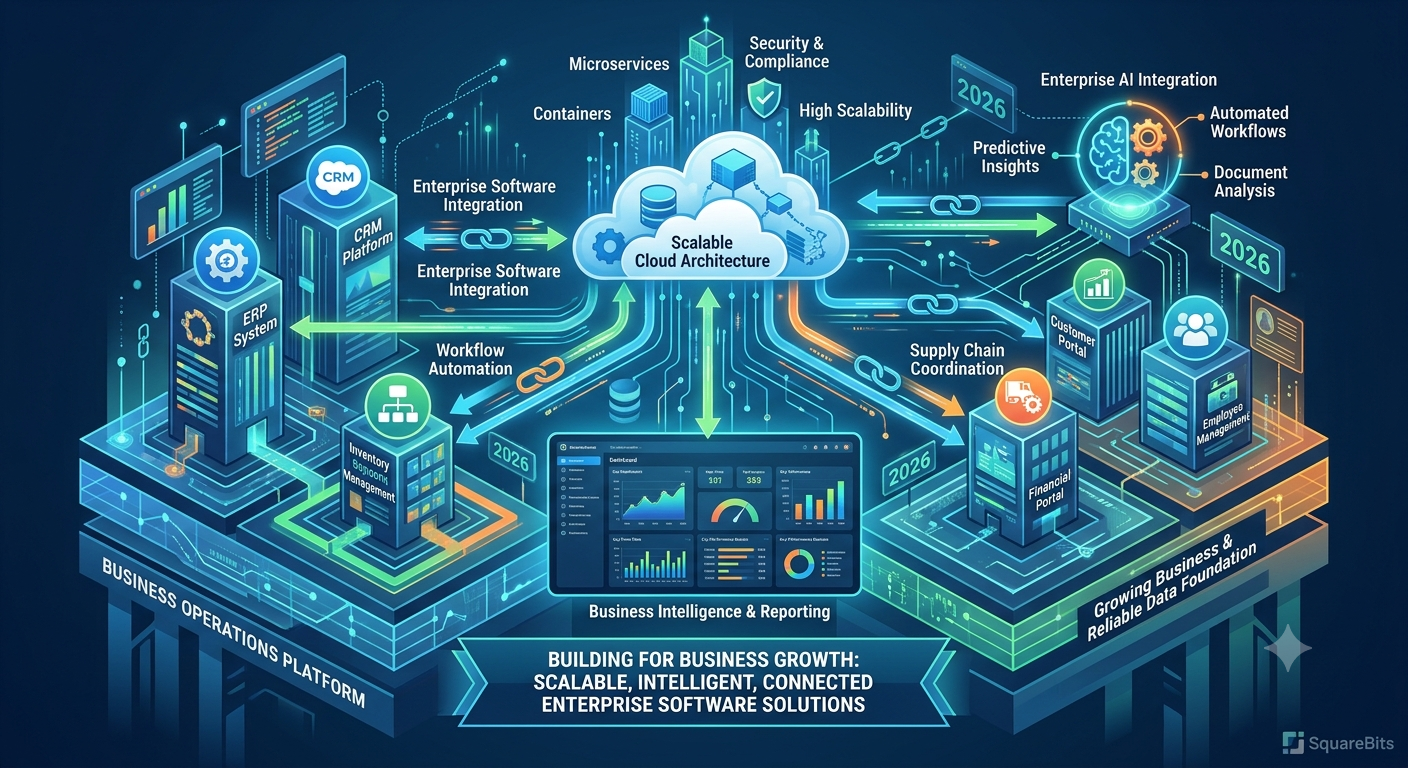
In 2026, enterprise software development is moving beyond simply digitizing business processes. Organizations are looking for connected, intelligent, secure, and scalable applications that support long-term business objectives.
From AI-powered workflows to cloud-based platforms and custom enterprise applications, the right technology infrastructure can help businesses operate more efficiently.
But how do companies know when their existing software is holding them back?
Let’s explore the challenges, opportunities, and strategies shaping enterprise software development in 2026.
1. When Business Growth Exposes Software Limitations
Software that works well for a small team may struggle when an organization expands.
As businesses add employees, customers, locations, products, and operational processes, their technology requirements change.
Some common warning signs include:
- Employees repeatedly entering the same information into different systems.
- Departments maintaining separate customer or inventory records.
- Managers depending on manual reports to understand performance.
- Existing applications struggling with higher transaction volumes.
- Business systems failing to communicate with one another.
- Teams relying on outdated software with limited customization.
- Security and access management becoming harder to maintain.
These challenges can slow down daily operations and create unnecessary administrative work.
For example, a growing distribution company may use separate platforms for inventory, order management, accounting, and customer relationships. If these systems do not communicate effectively, employees may spend significant time reconciling information instead of focusing on business operations.
Enterprise software should help remove these barriers rather than introduce additional complexity.
2. Why Custom Enterprise Software Is Becoming a Strategic Investment
Off-the-shelf software can be useful for standard business requirements. However, some organizations have workflows that do not fit neatly into predefined software features.
Custom enterprise software provides an opportunity to build applications around specific business processes.
Depending on organizational requirements, custom solutions may include:
Enterprise Resource Planning (ERP)
ERP applications connect important business functions such as finance, procurement, inventory, production, and operations.
Customer Relationship Management (CRM)
Custom CRM applications can help businesses manage customer information, sales pipelines, communication, and reporting.
Enterprise Portals
Employee, partner, and customer portals provide centralized access to relevant information and business services.
Workflow Management Software
Custom workflow applications can automate approvals, task assignments, document processing, and internal coordination.
Business Intelligence Platforms
Integrated dashboards help decision-makers monitor business performance using information collected from multiple systems.
The biggest advantage of custom development is flexibility. Businesses can prioritize the features, integrations, and workflows that directly support their objectives.
3. AI Integration Is Changing Enterprise Applications
Artificial intelligence is becoming an important part of enterprise software strategy.
Instead of treating AI as a separate tool, businesses are increasingly exploring ways to incorporate intelligent capabilities into their existing applications.
Potential enterprise use cases include:
- AI-powered customer support
- Intelligent document processing
- Automated report generation
- Predictive business analytics
- Sales forecasting assistance
- Internal knowledge assistants
- AI-powered search
- Workflow automation using AI agents
For example, an enterprise application connected to an authorized knowledge base could allow employees to ask natural-language questions about company policies, operational procedures, or internal documentation.
Similarly, an AI-powered reporting system could summarize business data and help managers identify patterns that deserve further investigation.
However, enterprise AI requires reliable data, secure integrations, appropriate permissions, and output validation.
AI should support business decisions, not automatically replace human accountability.
4. Enterprise Software Integration: Connecting the Business Ecosystem
Most established organizations use multiple applications to manage different functions.
The challenge is ensuring these systems share information accurately and securely.
Enterprise software integration connects applications, databases, platforms, and services so that business information can move between them.
Common integration requirements include:
- CRM and ERP synchronization
- Payment gateway integration
- Inventory and order management
- HR and payroll systems
- Cloud platforms
- Business intelligence tools
- Third-party APIs
- Customer-facing mobile applications
Why API-Based Integration Matters
Application Programming Interfaces (APIs) allow software systems to exchange information through defined interfaces.
A well-designed API architecture can help businesses connect existing applications without rebuilding every system from scratch.
For example, an online ordering platform could send order information to an inventory system, update a CRM record, and trigger an accounting workflow.
The result is a more connected business environment with fewer manual handoffs.
5. Cloud-Native Architecture and Scalable Enterprise Applications
Modern enterprise applications need to support changing business requirements.
Cloud computing offers organizations flexible infrastructure options that can support application deployment, data storage, integrations, and changing workloads.
Depending on the project, cloud-based enterprise architecture may include:
Microservices Architecture
Microservices divide an application into smaller services that can be developed, deployed, and maintained independently.
This can improve flexibility, although it also introduces additional operational and monitoring complexity.
Containerization
Containers package applications and their dependencies into consistent environments, helping teams deploy software across different infrastructure platforms.
Serverless Computing
Serverless services allow developers to run selected application functions without managing the underlying server infrastructure directly.
Hybrid Cloud
Hybrid cloud architecture combines private infrastructure with public cloud services, allowing businesses to distribute workloads according to their security, performance, and operational needs.
The right architecture depends on application complexity, traffic patterns, integration requirements, security needs, and available technical resources.
6. Security and Compliance Must Be Built Into Enterprise Software
As businesses become more dependent on digital systems, security becomes a fundamental requirement.
Enterprise applications may process customer records, financial information, employee data, intellectual property, and confidential business documents.
A security-focused development approach should include:
Identity and access management: Ensure users can access only the information and functions required for their roles.
Data encryption: Protect sensitive information during transmission and storage.
Secure API development: Validate requests, authenticate users, and restrict unauthorized access.
Audit logging: Maintain records of important application activities and administrative actions.
Regular security testing: Identify vulnerabilities through code reviews, dependency checks, and appropriate security assessments.
Backup and recovery: Prepare for unexpected failures, data loss, and service disruptions.
Compliance planning: Evaluate applicable privacy, industry, contractual, and regulatory requirements.
Security should be considered throughout the software development lifecycle rather than added after the application is complete.
7. Five Enterprise Software Trends Businesses Should Watch in 2026
Enterprise software is evolving as organizations adopt new technologies and rethink how applications support business operations.
A. AI-First Application Design
AI is increasingly being considered during application planning rather than added as an afterthought.
Businesses are exploring intelligent search, predictive features, document analysis, and AI-assisted workflows.
B. Agentic AI Workflows
AI agents can use authorized tools and APIs to perform defined tasks across business applications.
Potential use cases include processing requests, gathering information, preparing reports, and coordinating workflows.
Organizations must establish permission boundaries, monitoring, and human approval for sensitive actions.
C. Legacy Software Modernization
Older systems can become expensive to maintain and difficult to integrate with modern platforms.
Modernization may involve updating architecture, improving APIs, migrating databases, strengthening security, or rebuilding selected application components.
D. Low-Code and No-Code Integration
Low-code platforms can help businesses create internal tools and automate workflows faster.
However, enterprise use still requires governance, access controls, integration planning, and maintenance.
E. Data-Driven Decision Support
Businesses are investing in analytics and reporting systems that bring information from different departments into a more consistent view.
Better data accessibility can help managers identify trends and evaluate operational performance.
8. How to Know Whether Your Business Needs Custom Enterprise Software
Not every company needs a completely custom platform.
Before investing in development, businesses should evaluate their current systems and identify the problems they need to solve.
Custom enterprise software may be worth considering when:
- Existing applications cannot support important business workflows.
- Multiple departments depend on disconnected systems.
- Standard software requires too many workarounds.
- Manual processes are consuming significant employee time.
- The company needs integrations that available products do not provide.
- Security or data ownership requirements demand greater control.
- The organization needs a platform that can evolve with its business model.
A structured discovery process helps determine whether custom development, software integration, modernization, or a combination of approaches is most appropriate.
9. The Enterprise Software Development Process
Building enterprise software requires a clear development strategy.
A typical project follows several stages.
Step 1: Business Requirement Analysis
Developers and stakeholders identify business objectives, existing operational challenges, user requirements, and technical constraints.
Step 2: Architecture and Technology Planning
The team selects an appropriate architecture, technology stack, database design, and integration approach.
Step 3: UI/UX Design
Interfaces and user workflows are designed to make the application practical and accessible for its intended users.
Step 4: Application Development
Developers build the required modules, APIs, business logic, and integrations.
Step 5: Testing and Quality Assurance
The application is tested for functionality, performance, security, compatibility, and reliability.
Step 6: Deployment
The software is deployed to the selected infrastructure with appropriate configuration, access management, and monitoring.
Step 7: Maintenance and Continuous Improvement
Regular updates, performance monitoring, security improvements, and new features help the application remain useful as business requirements evolve.
Enterprise software is a long-term investment, so maintenance and scalability should be considered from the beginning.
10. How to Choose the Right Enterprise Software Development Partner
Selecting a software development partner is an important business decision.
A capable development team should understand both technical requirements and the operational challenges the application is expected to solve.
Consider evaluating partners based on:
- Experience with enterprise application development
- Custom software engineering capabilities
- API and third-party system integration
- Cloud architecture and infrastructure
- AI and automation expertise
- Security-focused development practices
- Quality assurance and testing
- Post-launch support and maintenance
- Clear communication and project management
Ask potential partners how they approach requirements gathering, architecture decisions, data migration, testing, and ongoing support.
The goal should be to find a team that can build software around your business objectives, not simply deliver a collection of features.
Frequently Asked Questions (FAQs)
1. What is enterprise software development?
Enterprise software development is the process of building applications that support the operations, workflows, and information requirements of organizations. Examples include ERP platforms, CRM systems, business portals, workflow applications, and analytics platforms.
2. What is the difference between custom and off-the-shelf enterprise software?
Off-the-shelf software provides predefined features designed for a broad market. Custom enterprise software is developed around an organization’s specific processes, integrations, and business requirements.
3. Why do businesses need scalable enterprise applications?
Scalable applications can accommodate changing workloads, growing user numbers, additional business functions, and increasing data requirements without requiring a complete redesign every time the business expands.
4. How does AI improve enterprise software?
AI can support document processing, predictive analytics, intelligent search, customer support, reporting, and workflow automation. Its effectiveness depends on reliable data and appropriate implementation.
5. What is enterprise software integration?
Enterprise software integration connects different business applications so they can exchange information and coordinate processes through APIs, middleware, event-driven systems, or other integration methods.
6. How much does custom enterprise software development cost?
Costs depend on application complexity, features, integrations, infrastructure, security requirements, development time, and ongoing maintenance. A detailed discovery and requirements assessment is needed for an accurate estimate.
7. What technologies are used in enterprise software development?
Common technologies include Java, .NET, Python, JavaScript, cloud platforms, relational and NoSQL databases, APIs, containers, and AI services. The right combination depends on project requirements.
8. How long does enterprise software development take?
The timeline depends on project scope, complexity, integrations, testing requirements, and stakeholder availability. A focused initial release may take less time than a comprehensive enterprise platform.
9. Can legacy enterprise software be modernized without replacing it completely?
Yes. Businesses can modernize selected components, introduce APIs, improve interfaces, migrate databases, or gradually replace outdated modules while keeping important existing systems operational.
10. How do I choose an enterprise software development company?
Review the company’s technical expertise, enterprise project experience, security practices, integration capabilities, communication process, and ability to provide long-term maintenance.
Conclusion
Business growth should create new opportunities, not expose limitations in the software that supports everyday operations.
In 2026, enterprise software development is increasingly focused on scalability, integration, AI capabilities, security, and long-term adaptability.
Organizations that invest in the right software architecture can improve operational visibility, reduce manual work, connect business systems, and prepare for changing technology requirements.
The most effective enterprise applications are not necessarily the ones with the largest number of features. They are the ones that solve meaningful business problems and continue to support the organization as it grows.
SquareBits believes software should work as a strategic business asset. By combining thoughtful engineering, modern technologies, and business-focused development, organizations can build digital solutions that support sustainable growth.
Leave a Reply