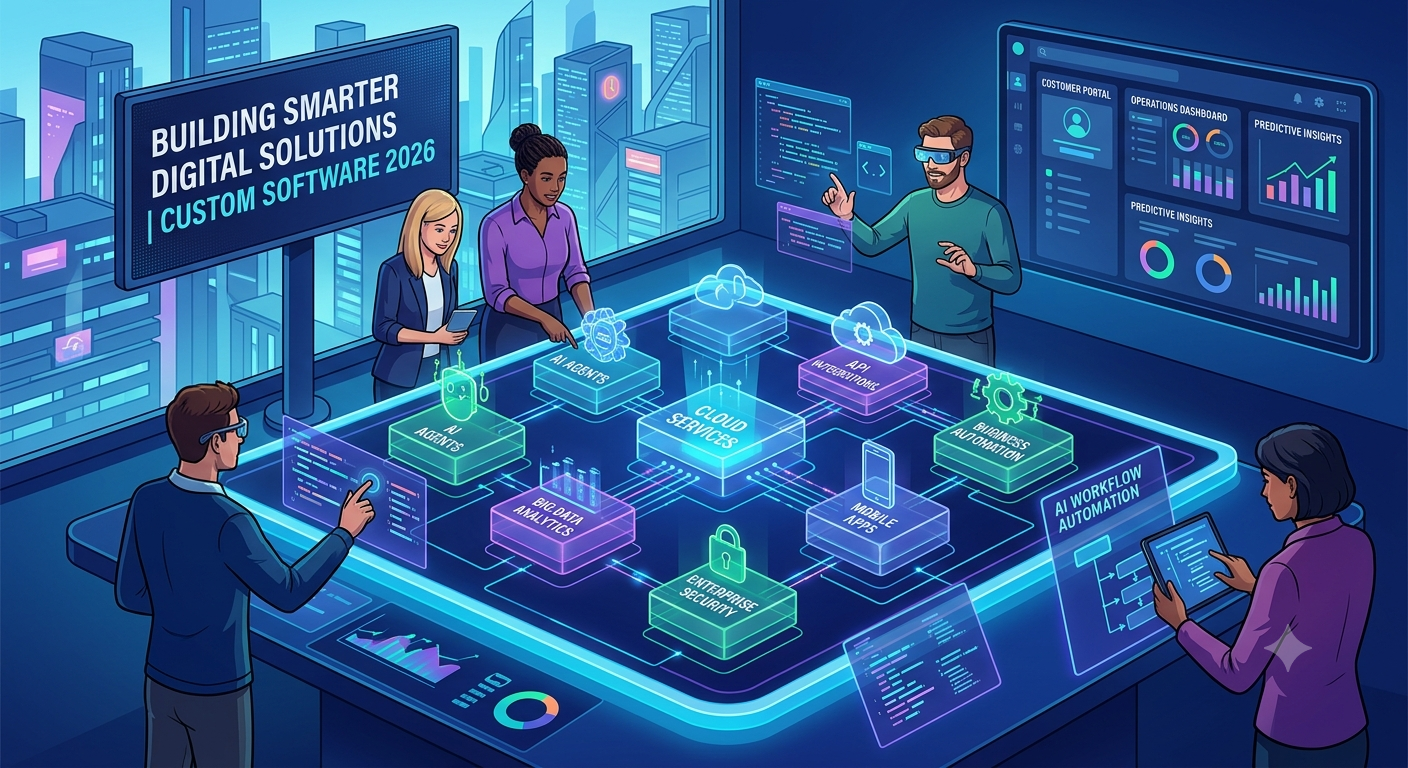
Businesses are increasingly relying on software to manage operations, serve customers, automate workflows, analyze information, and create new digital experiences.
Off-the-shelf software can solve many common business requirements, but growing organizations often need functionality that standard products cannot provide.
This is where custom software development becomes valuable.
A custom software solution is designed around the specific processes, requirements, users, integrations, and goals of a business.
In 2026, custom software development is also evolving with technologies such as artificial intelligence, cloud computing, API integrations, automation, data analytics, and modern application architectures.
For enterprises planning new software, the goal is no longer simply to build an application. It is to create a secure, scalable, and adaptable digital system that can support the business as it grows.
What Is Custom Software Development?
Custom software development is the process of designing, developing, testing, deploying, and maintaining software specifically for an organization’s requirements.
Unlike ready-made software, custom applications can be designed around existing business workflows.
Custom software can include:
- Enterprise web applications
- Mobile applications
- SaaS platforms
- Business management systems
- Customer portals
- Internal enterprise tools
- Workflow automation platforms
- Cloud applications
- AI-powered applications
- Data and analytics platforms
- API-driven systems
For example, a company may have a sales process involving multiple systems.
A custom application can connect those systems into a single workflow:
Customer Inquiry → CRM → Sales Team → Proposal → Approval → Contract → Billing
Instead of employees manually moving information between different systems, software can automate parts of the process.
Why Do Businesses Need Custom Software?
Every organization has different processes.
A standard software product may require employees to change their workflow to match the product.
Custom software takes the opposite approach.
The application can be designed around the organization’s workflow.
Businesses may consider custom software when they need:
- Unique functionality
- Integration with existing systems
- Automated workflows
- Custom reporting
- Industry-specific features
- Advanced security
- Scalability
- Greater control over data
- AI capabilities
- Custom customer experiences
The business case should be evaluated based on the organization’s actual requirements and expected return on investment.
Custom Software vs. Off-the-Shelf Software
Both approaches can be appropriate depending on the situation.
Off-the-Shelf Software
Ready-made software is generally designed for a broad group of users.
Advantages can include:
- Faster deployment
- Established functionality
- Predictable subscription models
- Existing documentation
- Vendor-supported updates
However, organizations may encounter limitations when their processes are highly specialized.
Custom Software
Custom applications can be designed specifically for the organization.
Potential advantages include:
- Customized workflows
- Flexible integrations
- Custom user interfaces
- Business-specific functionality
- Greater control over architecture
- Ability to evolve the product
The right choice depends on factors such as business requirements, budget, timeline, integration needs, and long-term strategy.
AI in Custom Software Development
Artificial intelligence is becoming an increasingly important component of modern software.
Businesses can integrate AI into custom applications for:
- Document processing
- Customer support
- Data analysis
- Content generation
- Recommendations
- Forecasting
- Search
- Workflow automation
- Information extraction
- Intelligent assistants
For example:
Customer Request → AI Classification → Business Rules → CRM Update → Employee Notification
This can automate repetitive steps while keeping business logic under the organization’s control.
Generative AI Applications
Generative AI can be integrated into enterprise software to create and transform information.
Applications can use generative AI for:
- Text generation
- Document summarization
- Report creation
- Knowledge assistants
- Email drafting
- Content transformation
- Natural-language search
- Internal employee assistance
However, AI-generated information should be validated according to the requirements and risk level of the application.
For business-critical workflows, organizations may combine AI with structured data, business rules, human review, and validation mechanisms.
AI Agents and Business Automation
AI agents can extend traditional software automation by allowing applications to perform multi-step tasks.
A simplified workflow could look like:
User Request → AI Agent → Retrieve Information → Analyze Data → Call Business API → Complete Task
For example, an enterprise assistant could help an employee retrieve customer information, summarize account activity, and prepare a follow-up task.
The level of automation should be carefully controlled, particularly when AI agents can access sensitive business systems.
Cloud-Based Custom Software
Cloud infrastructure has become an important foundation for modern business applications.
A cloud-based application can provide:
- Scalable infrastructure
- Remote access
- Centralized data
- Automated deployment
- Monitoring
- Backup capabilities
- Integration with cloud services
A typical architecture might include:
Web/Mobile Application → API Layer → Application Services → Database → Cloud Infrastructure
The architecture should be selected according to expected traffic, data requirements, security, availability, and business needs.
API Integration
Modern organizations often use multiple software systems.
For example:
- CRM
- ERP
- Accounting
- Payment systems
- Marketing platforms
- Inventory systems
- HR systems
- Communication platforms
APIs can allow these systems to exchange information.
Custom software can act as an integration layer between existing applications.
For example:
CRM → Custom Business Application → ERP
This can reduce manual data entry and help create more connected business processes.
Enterprise Web Application Development
Enterprise web applications can provide centralized access to business functionality.
Examples include:
- Customer portals
- Employee portals
- Operations dashboards
- Business management platforms
- Analytics applications
- Workflow systems
An enterprise web application should be designed with security, performance, scalability, accessibility, and maintainability in mind.
Mobile Application Development
Mobile applications can extend business systems beyond the desktop.
Businesses can develop mobile applications for:
- Field employees
- Sales teams
- Customers
- Service technicians
- Delivery teams
- Managers
Mobile applications can connect directly to backend APIs and provide access to business information from different environments.
Data and Analytics
Custom software can help organizations transform operational data into useful business information.
A data platform may collect information from:
CRM + ERP + Website + Mobile App + IoT Devices
↓
Central Data Platform
↓
Analytics & Reporting
↓
Business Insights
Custom dashboards can be designed around the metrics that matter to a specific organization.
Custom Software Security
Security should be incorporated into the software development lifecycle.
Important areas include:
Authentication
Users should be securely authenticated before accessing protected systems.
Authorization
Access should be based on the user’s role and responsibilities.
Encryption
Sensitive information should be protected appropriately during transmission and storage.
API Security
APIs should use appropriate authentication, authorization, validation, and monitoring controls.
Secure Development
Developers should follow secure coding practices and regularly address vulnerabilities.
Monitoring
Applications should generate appropriate logs and security events to support monitoring and investigation.
Scalable Software Architecture
A business application that works for 100 users may need a different architecture when it reaches thousands or millions of users.
Scalability should therefore be considered during the architecture phase.
Potential approaches include:
- Modular architecture
- Microservices where appropriate
- Containerization
- Cloud infrastructure
- Caching
- Load balancing
- Database optimization
- Asynchronous processing
Not every application needs a highly distributed architecture.
The goal should be to select the simplest architecture that can reliably support current and expected requirements.
Custom Software Development Process
A structured development process can improve project visibility and reduce unnecessary development.
Step 1: Business Discovery
The development team should understand:
- Business objectives
- Existing workflows
- Users
- Pain points
- Required integrations
- Security requirements
Step 2: Requirements Definition
Functional and technical requirements can then be documented.
This may include:
- Features
- User roles
- Data requirements
- APIs
- Reports
- Notifications
- Security controls
Step 3: UI/UX Design
The user experience should be designed around how employees or customers will actually use the software.
Step 4: Architecture
The development team can define:
- Frontend
- Backend
- Database
- APIs
- Cloud infrastructure
- Security
- Integration architecture
Step 5: MVP Development
The first version should focus on the most important functionality.
An MVP allows the organization to validate the product before investing in every planned feature.
Step 6: Testing
Testing can cover:
- Functional requirements
- Performance
- Security
- API integrations
- Mobile compatibility
- User experience
- Data accuracy
Step 7: Deployment
The application can then be deployed to the selected infrastructure.
Step 8: Maintenance
After launch, software may require:
- Security updates
- Performance improvements
- New features
- Bug fixes
- Infrastructure updates
- Third-party integration updates
Common Custom Software Development Challenges
Custom software provides flexibility, but development projects can also face challenges.
Unclear Requirements
Poorly defined requirements can result in changing scope and unnecessary development.
Excessive Features
Trying to build every possible feature in the first release can increase cost and development time.
Integration Complexity
Connecting multiple legacy and third-party systems can require significant technical planning.
Security Gaps
Security problems discovered late in development can require expensive architectural changes.
Poor Scalability Planning
Applications should be designed according to realistic current and future requirements.
Lack of Post-Launch Planning
Software development does not necessarily end at launch. Long-term maintenance should be considered from the beginning.
How to Choose a Custom Software Development Company
Selecting a development partner requires more than comparing development rates.
Businesses should evaluate:
Technical Expertise
Look for experience with the technologies required by the project.
Industry Understanding
A development team that understands the business context can better translate requirements into software.
Architecture Experience
Ask how the team approaches scalability, security, integrations, and maintainability.
AI Capabilities
If AI is part of the roadmap, evaluate experience with AI APIs, LLMs, machine learning, RAG, or AI agents as relevant.
Communication
Clear communication helps prevent misunderstandings around requirements, timelines, and scope.
Testing and Security
Ask about testing methodologies, code reviews, security testing, and deployment practices.
Long-Term Support
Consider whether the development partner can support the application after launch.
Custom Software Development Cost
The cost of a custom software project depends on its scope and technical complexity.
Important factors include:
- Number of platforms
- Application complexity
- Number of users
- UI/UX requirements
- Backend architecture
- API integrations
- Database requirements
- AI functionality
- Security requirements
- Cloud infrastructure
- Testing
- Maintenance
A small internal application and a large enterprise platform can have completely different development requirements.
Businesses should therefore define the product scope and technical requirements before requesting a detailed estimate.
The Future of Custom Software Development
Custom software development is moving toward more intelligent and interconnected applications.
Businesses are increasingly combining:
- Artificial intelligence
- Cloud computing
- Automation
- Data analytics
- API ecosystems
- Mobile applications
- IoT
- Enterprise platforms
This creates opportunities for software that does more than store information.
Modern applications can potentially:
Collect Data → Understand Information → Automate Workflows → Generate Insights → Support Business Decisions
The result is a shift from traditional software toward intelligent digital platforms.
Conclusion
Custom software development allows businesses to create applications around their specific workflows, users, data, and operational requirements.
Modern custom applications can combine web and mobile development, cloud infrastructure, APIs, AI, automation, analytics, and secure enterprise architecture.
The most important step is to start with the business problem rather than the technology.
Once the objectives are clear, the development team can select the architecture and technologies that provide the required functionality while keeping security, scalability, usability, and long-term maintenance in mind.
Build Your Custom Software Solution With SquareBits
SquareBits helps businesses explore and develop custom software, enterprise applications, web and mobile solutions, cloud platforms, API integrations, AI-powered applications, and business automation systems.
If your organization is relying on disconnected tools, manual workflows, or software that does not fit your processes, a custom digital solution can help bring the required functionality into a more integrated platform.
Primary SEO keywords: custom software development, custom software development company, enterprise software development, custom application development, business software development, software development company, custom web application development
Suggested URL slug: /custom-software-development/
Suggested Meta Title: Custom Software Development Company | SquareBits
Suggested Meta Description: Build scalable custom software for your business with web, mobile, cloud, AI, API integration, automation, analytics, and secure enterprise solutions.
Suggested internal links: enterprise software development, AI app development, mobile app development, web application development, cloud software development, business automation, API integration
Leave a Reply