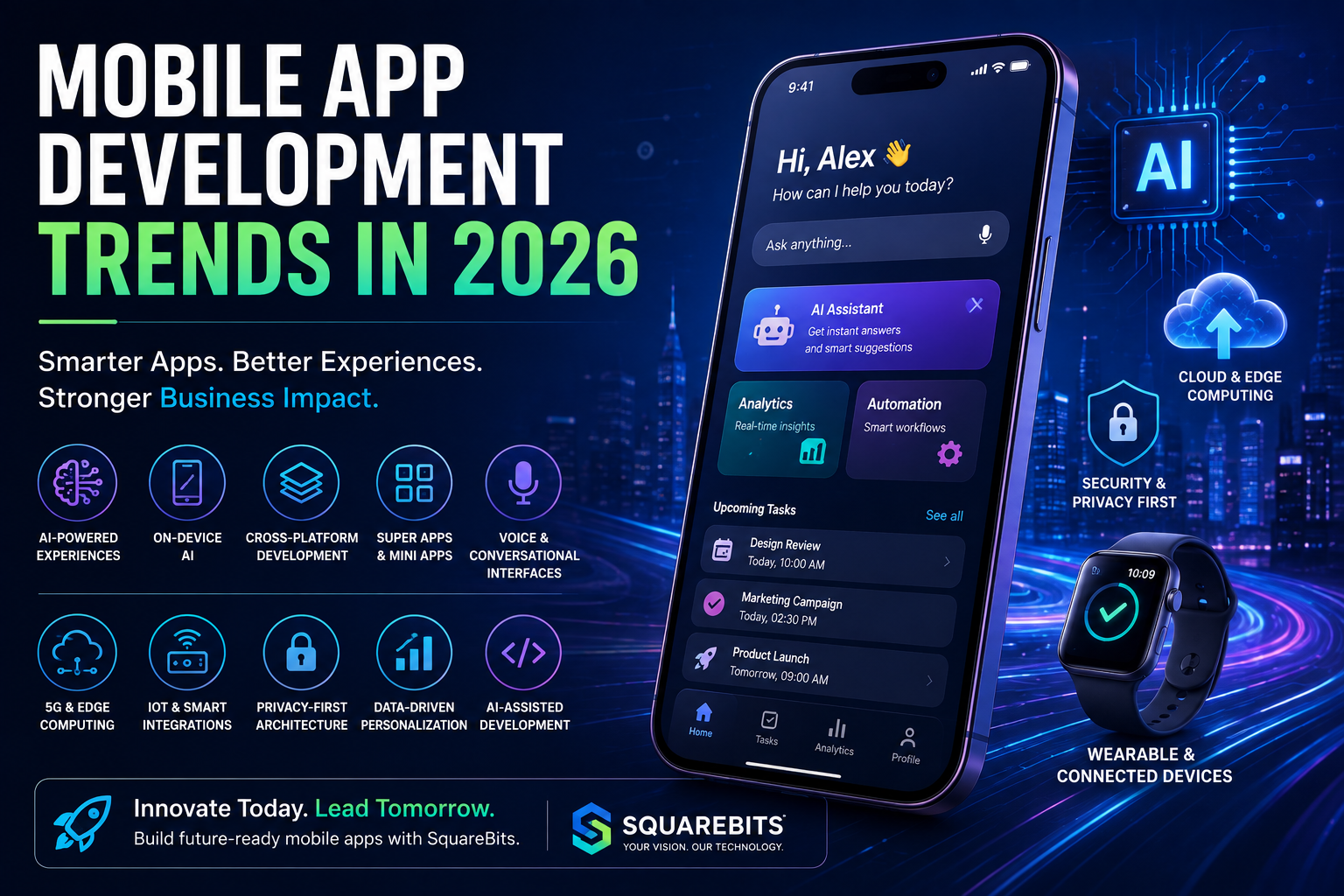
Mobile apps are no longer just digital versions of websites.
In 2026, businesses are building mobile applications that can understand users, personalize experiences, automate tasks, connect with smart devices, and even make intelligent decisions.
Artificial intelligence is becoming deeply integrated into mobile experiences, while cross-platform development has matured enough to make a single codebase a practical choice for many businesses. At the same time, privacy, security, on-device processing, connected devices, and faster user experiences are becoming increasingly important.
But here’s the important part:
Businesses don’t need to adopt every new technology.
The real challenge is identifying which mobile app development trends can create measurable value for customers and the business.
Let’s explore the most important mobile app development trends shaping 2026.
1. AI-Native Mobile Apps Are Becoming the New Standard
One of the biggest changes in mobile app development is the transition from apps that simply include AI features to apps that are designed around AI.
Earlier, adding AI to an application might have meant adding a chatbot or recommendation engine.
In 2026, AI can become part of the core experience.
For example, an eCommerce app could use AI to:
- Understand natural-language product searches
- Recommend products
- Personalize the shopping experience
- Answer customer questions
- Predict purchasing preferences
- Assist with customer service
A financial application could use AI to analyze spending patterns and provide personalized insights.
A healthcare application could use AI to help users navigate information and services.
The important question for businesses is no longer:
“Should we add AI?”
It is:
“Where can AI make our application genuinely more useful?”
2. AI Agents Are Moving Into Mobile Apps
Chatbots answer questions.
AI agents can potentially complete tasks.
That distinction is becoming increasingly important.
A traditional travel app might allow users to search for flights and hotels manually.
An AI-powered travel agent could understand:
“Find me a three-day business trip to London next month, preferably near the city center and within my budget.”
The application could then potentially:
- Understand the request
- Search available options
- Compare results
- Present recommendations
- Ask for confirmation
- Complete authorized actions
This represents a shift from search-driven apps to intent-driven apps.
AI agents are also contributing to renewed interest in “super app” experiences, where multiple services can be brought together through a unified AI-driven interface.
What businesses should consider
If you’re developing a mobile app in 2026, think about whether users are simply consuming information or whether your application could help them accomplish a goal.
That is where AI agents can create significant value.
3. On-Device AI Is Growing
Not every AI request needs to be processed in the cloud.
Modern smartphones increasingly have hardware and software capabilities that allow certain AI workloads to run directly on the device.
This is known as on-device AI.
It can provide several advantages:
- Faster responses
- Better privacy
- Lower network dependency
- Offline functionality
- Reduced cloud inference costs
- More responsive user experiences
For example, an app could process certain images, speech, recommendations, or classification tasks locally instead of sending every request to a remote server.
A hybrid approach can also be useful:
Small AI task → Device
Complex AI task → Cloud
Current 2026 mobile-development analysis identifies on-device AI as one of the most significant architectural shifts, particularly because of the combination of privacy, latency, and cost advantages.
4. Cross-Platform Development Is More Mature
Businesses have traditionally faced a choice:
Build separately for iOS and Android
or
Use a cross-platform framework.
In 2026, cross-platform technologies such as Flutter, React Native, and Kotlin Multiplatform are mature enough to support a wide range of production applications.
A shared codebase can help businesses:
- Reduce duplicated development
- Launch faster
- Simplify maintenance
- Maintain consistent features
- Reduce development effort
However, native development still has an important place.
Apps requiring highly specialized hardware integration, advanced graphics, or platform-specific functionality may benefit from native development.
So the question isn’t:
“Is native or cross-platform better?”
It’s:
“Which architecture is right for this particular product?”
5. Super Apps and Mini-App Ecosystems
The idea of a super app is gaining renewed attention.
Instead of asking users to install separate applications for every service, a super app can bring multiple functions into one ecosystem.
For example:
One App → Payments + Shopping + Messaging + Booking + Rewards
AI is making this concept more interesting because users can interact with multiple services through a conversational interface.
Instead of navigating through five different menus, a user could simply describe what they want.
Businesses don’t necessarily need to build a giant super app.
A more realistic approach can be developing a modular ecosystem where additional services can be added over time.
6. Privacy-First Mobile App Development
Users are becoming more conscious of how applications collect and use their data.
At the same time, businesses are facing increasing pressure to protect customer information.
Privacy therefore needs to be considered during architecture—not after development.
Modern mobile applications should consider:
- Secure authentication
- Encryption
- Data minimization
- Permission management
- Secure API communication
- Privacy-aware analytics
- Access controls
- Secure storage
- Transparent data policies
On-device AI can also contribute to privacy by allowing certain data processing to happen locally.
A privacy-first application isn’t just more secure.
It can also create greater trust with users.
7. Voice Interfaces Are Becoming More Useful
Typing isn’t always the best way to interact with a mobile application.
Voice interfaces can make certain experiences faster and more natural.
Potential applications include:
- Voice shopping
- AI assistants
- Customer service
- Healthcare applications
- Navigation
- Productivity apps
- Field-service applications
- Accessibility features
The combination of:
Speech Recognition + AI + Business APIs + Voice Response
can create completely new mobile experiences.
Instead of navigating through multiple screens, users can simply tell the application what they need.
8. Multimodal Mobile Experiences
AI isn’t limited to text.
Mobile applications can increasingly work with:
- Text
- Images
- Voice
- Video
- Documents
- Sensor data
Imagine a retail application where a customer takes a picture of a product and asks:
“Can you find something similar?”
Or a productivity app where a user uploads a document and asks the application to summarize it.
This is called multimodal AI.
For businesses, multimodal applications can create more natural interactions because users aren’t forced to communicate through one format.
9. 5G and Edge Computing Will Enable Richer Experiences
Faster networks aren’t simply about downloading files more quickly.
They enable new types of applications.
5G and edge computing can support:
- Real-time collaboration
- Cloud gaming
- Connected vehicles
- AR experiences
- IoT applications
- Live video
- Industrial monitoring
- Real-time analytics
Edge computing can move processing closer to the user or device, reducing latency for applications that require rapid responses.
This becomes particularly valuable when mobile applications communicate with IoT devices or real-time systems.
10. Mobile Apps and IoT Are Becoming More Connected
Mobile apps are increasingly becoming control centers for connected devices.
For example:
Mobile App → Cloud → IoT Device
or:
IoT Sensor → Mobile App → AI → Recommended Action
Businesses can use these architectures for:
- Smart homes
- Healthcare devices
- Industrial monitoring
- Fleet management
- Retail
- Agriculture
- Smart buildings
- Wearables
For companies already investing in IoT, mobile applications can provide the user-facing layer that makes connected technology practical.
11. Wearable Integration Is Expanding
Smartwatches and wearable devices are becoming increasingly useful extensions of mobile applications.
Instead of requiring users to open their smartphones for every interaction, certain information can be delivered directly to the wearable.
Potential applications include:
- Health and fitness
- Notifications
- Payments
- Navigation
- Productivity
- Safety
- Connected-device control
For businesses developing mobile applications, wearable support can create additional engagement opportunities.
12. Foldable and Large-Screen Experiences Matter
Mobile hardware is evolving.
Foldable phones and larger-screen mobile devices create new possibilities for application design.
An app may need to support:
- Multiple screen sizes
- Different orientations
- Split-screen experiences
- Flexible layouts
- Larger information panels
- Multi-window workflows
This means responsive design isn’t only about phones and tablets anymore.
Developers need to think about how the application behaves when the device itself changes shape or screen configuration.
13. Offline-First Apps Are Becoming More Important
A mobile application shouldn’t necessarily become useless when the internet connection disappears.
Offline-first architecture allows selected functionality to continue working without a constant network connection.
For example:
Online → Cloud Synchronization
Offline → Local Data
Connection Restored → Sync
This can be especially useful for:
- Field-service apps
- Delivery applications
- Retail POS
- Logistics
- Travel
- Industrial applications
- Rural services
Offline capability can also improve user experience in areas with unstable connectivity.
14. AI-Powered Personalization
Users increasingly expect applications to understand their individual needs.
AI can analyze authorized behavioral and contextual information to personalize:
- Recommendations
- Notifications
- Search results
- Content
- Offers
- User journeys
For example, two customers using the same shopping app may see different recommendations based on their preferences and previous interactions.
However, personalization should always be balanced with privacy and transparency.
15. Mobile App Security Is Becoming a Business Priority
As applications become more connected, they also become more attractive targets for attackers.
Modern applications should consider:
- Multi-factor authentication
- Biometric authentication
- Secure APIs
- Encryption
- Token management
- Secure storage
- Runtime protection
- Regular security testing
- Fraud detection
AI-powered applications introduce additional security considerations, particularly when AI systems can access customer or business data.
Security should therefore be included from the earliest architecture discussions.
16. AI-Assisted App Development Is Accelerating
AI isn’t only changing the applications users interact with.
It’s also changing how developers build those applications.
AI coding tools can assist with:
- Code generation
- Debugging
- Testing
- Documentation
- Refactoring
- UI development
- Code review
Research published in 2026 analyzed 2,901 AI-authored pull requests across 193 Android and iOS open-source repositories, providing evidence that AI coding agents are already contributing to mobile development workflows.
But AI-generated code still requires experienced developers.
The strongest development teams will use AI to accelerate engineering—not eliminate engineering discipline.
17. Accessibility Will Become a Bigger Part of App Design
An excellent mobile application should work for as many users as possible.
Accessibility considerations can include:
- Screen-reader support
- Voice navigation
- Appropriate color contrast
- Scalable text
- Keyboard accessibility
- Clear navigation
- Captions
- Alternative descriptions
Accessibility isn’t simply a compliance issue.
It can improve usability for everyone.
18. App Performance and Battery Efficiency Matter More
Users don’t want an application that consumes excessive battery, takes too long to load, or frequently crashes.
In 2026, performance optimization should include:
- Fast startup
- Efficient network requests
- Optimized images
- Lightweight architecture
- Efficient background processing
- Memory management
- Battery-conscious design
This becomes particularly important for AI-powered applications because AI workloads can increase CPU, GPU, memory, network, and battery usage.
19. Mobile Monetization Is Becoming More Flexible
The traditional paid-download model is no longer the only option.
Businesses can combine:
- Subscriptions
- Freemium
- In-app purchases
- Advertising
- Transaction fees
- Premium features
- Enterprise licensing
AI applications are also introducing new monetization considerations because cloud AI inference can create ongoing operating costs.
Therefore, businesses should design monetization and AI infrastructure together.
20. The Best Apps Will Combine Multiple Trends
The biggest opportunity isn’t necessarily one individual trend.
It’s the combination.
Imagine a future retail application:
AI Agent + On-Device AI + Voice + Personalization + IoT + Cloud
A customer could speak naturally to the application, receive personalized recommendations, interact with connected devices, and complete transactions through one experience.
This is where mobile application development is heading:
Less navigation. More intelligence.
Which Mobile App Trends Should Your Business Adopt?
This is the question businesses should really be asking.
You don’t need all 20 trends.
Instead, evaluate your product using four questions.
1. What problem are we solving?
Start with the customer problem—not the technology.
2. Which technology improves the experience?
If AI doesn’t improve the product, don’t add AI just because it is trending.
3. What will create measurable ROI?
Consider:
- Revenue
- Customer retention
- Operational efficiency
- Automation
- Customer satisfaction
- Development efficiency
4. Can the architecture scale?
A successful application needs to support future users, features, integrations, and data.
Native vs Cross-Platform: Which Should You Choose?
There is no universal answer.
Choose Native Development When:
- You need deep platform integration
- Performance is extremely important
- You require specialized hardware capabilities
- You need advanced platform-specific functionality
Consider Cross-Platform Development When:
- You want faster development
- You need both iOS and Android
- Your product has a shared business logic
- You want simpler long-term maintenance
- You have a limited initial development budget
The right decision should come from product requirements rather than technology hype.
How Much Does Mobile App Development Cost in 2026?
There is no fixed price for developing a mobile application.
The total cost depends on:
- App complexity
- Number of platforms
- UI/UX requirements
- Backend development
- APIs
- AI features
- IoT integrations
- Payment systems
- Security requirements
- Admin dashboards
- Third-party integrations
- Testing
- Maintenance
A simple business application can have a very different budget from an enterprise platform with AI, real-time data, IoT, payments, and multiple integrations.
The best approach is to define the MVP first.
Then build the product in phases.
What Should Businesses Do in 2026?
Instead of chasing every technology trend, businesses should build a roadmap.
A practical roadmap could look like:
Phase 1: Define business problem
↓
Phase 2: Research users
↓
Phase 3: Define MVP
↓
Phase 4: Select technology architecture
↓
Phase 5: Design UX/UI
↓
Phase 6: Develop and test
↓
Phase 7: Launch MVP
↓
Phase 8: Analyze user behavior
↓
Phase 9: Add AI, automation, IoT, or advanced features where they create measurable value
This approach reduces unnecessary development and allows the product to evolve based on real customer feedback.
Why Businesses Need the Right Mobile App Development Partner
Technology changes quickly.
A development partner should therefore do more than simply write code.
A good mobile app development team should understand:
- Product strategy
- UX/UI
- Mobile architecture
- Backend systems
- APIs
- Cloud infrastructure
- AI integration
- Security
- Testing
- Scalability
- Post-launch maintenance
The goal isn’t simply to launch an app.
The goal is to build an application that can continue creating value as the business grows.
How SquareBits Can Help
At SquareBits, businesses can work with a technology team to transform mobile app ideas into scalable digital products.
A modern mobile development approach can include:
- iOS app development
- Android app development
- Cross-platform development
- React Native development
- Flutter development
- AI-powered mobile applications
- Enterprise mobile apps
- IoT-connected mobile applications
- Backend development
- API integration
- Cloud solutions
- UI/UX design
- App maintenance and support
Whether you’re building a new startup product, modernizing an existing application, or adding AI to an established mobile platform, the right architecture can help you move faster without sacrificing scalability.
Frequently Asked Questions
What are the biggest mobile app development trends in 2026?
The biggest trends include AI-native apps, AI agents, on-device AI, cross-platform development, super apps, multimodal experiences, 5G and edge computing, IoT integration, privacy-first development, wearables, offline-first architecture, and AI-assisted development.
Is AI important for mobile app development in 2026?
Yes, but AI should solve a real user or business problem. Useful applications include personalization, recommendations, automation, conversational interfaces, predictive analytics, and AI agents.
Is cross-platform app development a good choice in 2026?
For many applications, yes. Flutter, React Native, and Kotlin Multiplatform have matured considerably. However, native development can still be preferable for applications requiring deep platform-specific capabilities.
What is an AI-native mobile app?
An AI-native mobile app is designed around AI capabilities from the beginning rather than adding AI as a separate feature later.
What is on-device AI?
On-device AI processes certain AI workloads directly on a smartphone or other device instead of sending every request to a cloud server. This can improve latency, privacy, offline capability, and potentially reduce cloud inference costs.
Are super apps becoming popular?
Super-app concepts are receiving renewed attention, particularly as AI agents make it easier to combine multiple services behind a unified experience.
How much does it cost to develop a mobile app?
The cost depends on features, platforms, integrations, design complexity, AI requirements, backend architecture, security, and maintenance. A proper technical discovery process is needed to create an accurate estimate.
Final Thoughts
Mobile app development in 2026 is moving beyond screens, buttons, and menus.
The next generation of applications will be:
Smarter. More personalized. More connected. More secure.
AI will help applications understand users.
On-device processing will improve speed and privacy.
Cross-platform technologies will help businesses build efficiently.
IoT will connect applications to the physical world.
And AI agents will increasingly help users complete tasks instead of simply finding information.
But businesses shouldn’t adopt technology simply because it is trending.
The strongest mobile products will be the ones where technology, user experience, and business objectives work together.
Planning a mobile app in 2026? Start with the problem you want to solve—and choose the technology that makes that solution better.
Talk to SquareBits about building a scalable mobile application for your business.
Leave a Reply